
Shopify vs Etsy for Handmade Businesses: 2026 Guide

Table of Contents
- Shopify vs Etsy for Handmade Businesses: How Each Platform Works
- Shopify vs Etsy Fees Comparison: Full Pricing Breakdown
- Etsy vs Shopify Marketing Tools and Traffic Generation
- Pros and Cons of Each Platform for Handmade Sellers
- Handmade Business Website Examples: What Success Looks Like
- Migrating from Etsy to Shopify: What You Need to Know
- Which Platform Should Your Handmade Business Choose?
- Conclusion
Last Updated: May 26, 2026
Choosing the right selling platform is one of the most consequential decisions a handmade business owner will make. The debate around shopify vs etsy for handmade businesses comes up constantly in maker communities, and for good reason: the two platforms operate on fundamentally different philosophies. This guide from Embed360 breaks down exactly how each platform works, what it costs, and which one fits your specific situation. But first, here’s what most comparison guides get wrong: framing this as a beginner vs. pro decision. It’s not. It’s a question of where you are in your business lifecycle and what you’re willing to trade.
Shopify vs Etsy for Handmade Businesses: How Each Platform Works
A marketplace and a standalone storefront are two very different animals. Etsy is a marketplace where millions of buyers already browse for handmade, vintage, and unique goods. Shopify is an e-commerce platform that gives you the infrastructure to build your own digital storefront from scratch. Neither is inherently better. They serve different stages of business growth and different risk tolerances.
What Etsy Offers Handmade Sellers
Etsy is a global marketplace specifically built around handmade, vintage, and craft supply products. The platform’s core value is simple: buyers who want handmade goods already come here. You don’t have to convince them that handmade products are worth buying. They’re already sold on that idea.
Setting up an Etsy shop takes a few hours. You create listings, upload images, set prices, and you’re live. The built-in SEO and discovery tools help new shops surface in search results without any technical knowledge. Payment processing is integrated, and you get access to discounted shipping labels from day one.
The trade-off is real, though. You’re one of millions of sellers in the same marketplace. A buyer searching for "hand-poured soy candles" sees your listing right next to your competitor’s. You don’t own the customer relationship. You don’t control the customer experience beyond your product and packaging. Etsy can change its algorithm, raise fees, or suspend your shop with limited recourse.
Best for: Beginners, side hustle operators, and makers testing product-market fit before committing to a full e-commerce setup.
What Shopify Offers Handmade Sellers
Shopify is a comprehensive e-commerce platform that lets makers build a fully branded, independent online store. Full control over store design, customer data, email marketing, and the entire customer experience comes standard. You own your audience.
The infrastructure is built to scale. Shopify’s app ecosystem covers everything from inventory management to social media integration to advanced shipping rules. You can sync your store with Facebook and Instagram shops, run email marketing campaigns, and build a brand identity that no marketplace can dilute.
The catch: none of that traffic comes automatically. A Shopify store with no marketing is a storefront in an empty field. Customer acquisition is entirely your responsibility.
Best for: Growing handmade businesses ready to invest in marketing, own their customer relationships, and build long-term brand equity.
Shopify vs Etsy Fees Comparison: Full Pricing Breakdown
Understanding the real cost of each platform requires looking beyond the headline numbers. The Shopify vs Etsy fees comparison gets complicated quickly once you factor in transaction fees, payment processing, and optional tools.
Etsy Fees Explained
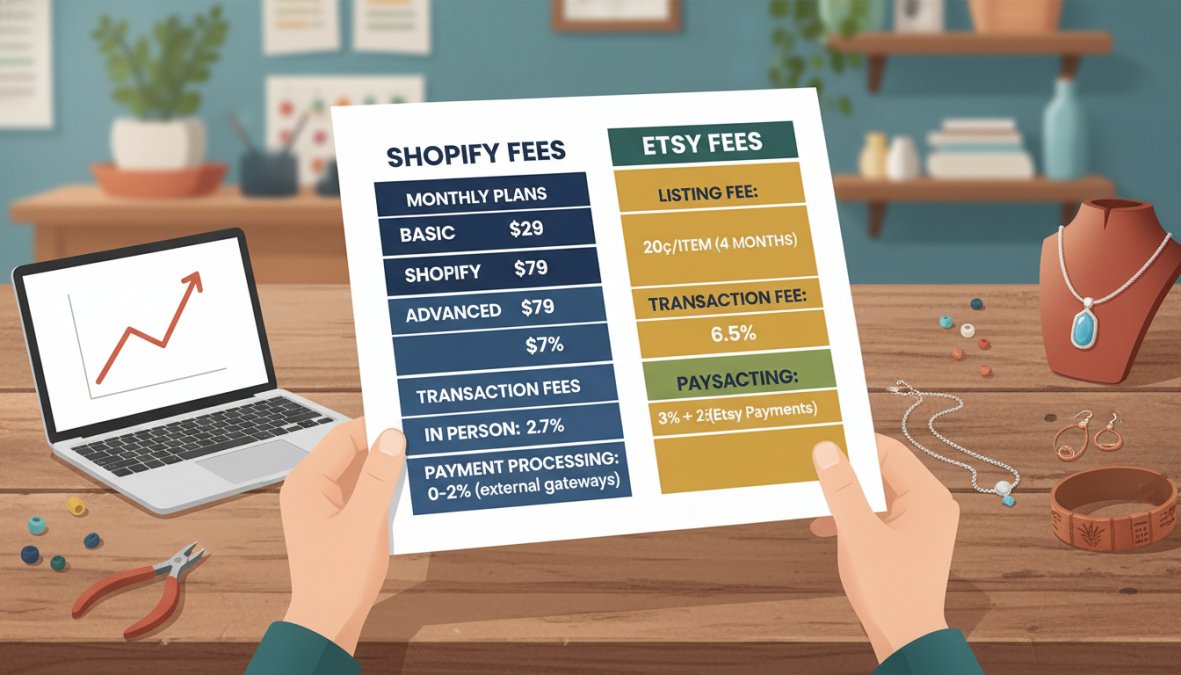
Etsy’s pricing model is transaction-based. There’s no monthly subscription required to run a basic shop, which makes startup costs low. Here’s the full breakdown:
- Listing fee: $0.20 per item listed (renews every 4 months or when sold)
- Transaction fee: 6.5% of the total sale price, including shipping
- Payment processing fee: Varies by country (in the US, approximately 3% plus a small flat fee)
- Etsy Plus (optional): A monthly subscription for additional customization features
- Offsite Ads: Etsy automatically enrolls sellers in its offsite ad program; if a sale comes through an ad, Etsy takes an additional percentage
For a handmade business doing low volume, the per-transaction model keeps costs proportional to revenue. But as sales grow, those transaction fees compound. Many sellers are surprised to find that Etsy’s effective take rate on each sale is significantly higher than it first appears.
Don’t calculate Etsy profitability using only the listing fee. Add up the transaction fee, payment processing fee, and any offsite ad fees together. Many sellers discover their actual profit margins are thinner than expected once all fees are counted.
Shopify Fees Explained
Shopify operates on a monthly subscription model. Plans start at $29 per month (billed annually) for the Basic plan. Here’s what matters for handmade sellers:
- Basic Shopify: Suitable for most small handmade businesses starting out
- Transaction fees: Zero if you use Shopify Payments; a percentage applies if you use a third-party payment processor
- Credit card processing: Competitive rates through Shopify Payments
- Apps: Many essential functions (email marketing, advanced SEO, inventory management) require paid apps
The monthly subscription cost applies regardless of whether you make any sales. For a side hustle with inconsistent revenue, that fixed cost can sting. For a business with steady volume, the predictable cost structure and lower per-transaction fees often work out cheaper than Etsy.
| Feature | Etsy | Shopify |
|---|---|---|
| Starting Cost | $0.20/listing | $29/month |
| Transaction Fee | 6.5% per sale | 0% (with Shopify Payments) |
| Monthly Subscription | None (basic) | Required |
| Built-in Traffic | Yes | No |
| Custom Domain | No | Yes |
| Brand Control | Limited | Full |
| Setup Complexity | Low | Moderate |
Etsy vs Shopify Marketing Tools and Traffic Generation
Here’s where the two platforms diverge most sharply, and where most guides fail to give you the full picture. The standard framing, ‘Etsy brings traffic, Shopify doesn’t’, is technically true but practically useless. What matters is understanding how each platform’s traffic engine works mechanically, because that determines what you actually have to do to get found.
How Etsy’s Internal Search Algorithm Works
Etsy’s search algorithm, sometimes referred to internally as its ranking system, evaluates listings across several documented signals. Understanding these signals is the difference between a listing that surfaces on page one and one that never gets seen.
Relevancy signals Etsy weighs:
- Title keywords: Etsy’s algorithm weights the first few words of your title most heavily. A title that opens with your primary keyword phrase, not your shop name, not a creative tagline, performs better in both Etsy search and in Google’s indexing of that listing page.
- Tags: Etsy gives you 13 tags per listing. Each tag should be a phrase, not a single word. ‘hand poured soy candle’ as a tag outperforms ‘candle’ because it matches how buyers actually search.
- Attributes: Category-specific attributes (material, color, occasion, style) feed Etsy’s filtered search. Sellers who skip attributes are invisible to buyers using those filters.
- Listing quality score: Etsy tracks click-through rate, conversion rate, and recency of sales on each listing. A listing that converts well gets surfaced more. This creates a compounding advantage for established listings and a cold-start problem for new ones.
- Shop quality signals: Your overall shop’s review score, completion rate on orders, and response time to messages all influence how Etsy weights your listings in competitive search results.
The important nuance: Etsy listings also rank in Google’s organic search results. A well-optimized Etsy listing for a specific long-tail query, ‘personalized leather bookmark with name’, can appear in Google search results and drive external traffic into your Etsy shop. This is free traffic that most Etsy sellers underutilize because they treat Etsy SEO as separate from Google SEO. They’re not separate. Etsy listing pages are indexed by Google, and title and description optimization affects both.
How SEO Works for a Shopify Store
Shopify SEO operates entirely differently because you’re optimizing for Google directly, with no intermediary algorithm. You control every element that Google uses to evaluate and rank your pages.
What Shopify gives you control over that Etsy does not:
- URL structure: On Etsy, your listing URL is assigned by the platform. On Shopify, you set your own URL slugs. A product URL like
/products/hand-poured-lavender-soy-candle-8ozis a ranking signal Etsy sellers can never access. - Meta titles and descriptions: Shopify lets you write custom meta titles and descriptions for every product, collection, and page. These appear in Google search results and directly affect click-through rates from organic search.
- Site architecture and internal linking: You can build collection pages that target category-level keywords (‘soy candles’, ‘beeswax candles’, ‘natural candles’) and link product pages into those collections in a way that distributes ranking authority across your site. Etsy’s structure doesn’t allow this.
- Page speed and Core Web Vitals: Google uses page experience signals as ranking factors. Shopify’s hosted infrastructure generally performs well on these metrics, and you can optimize further by choosing lightweight themes and limiting app bloat.
- Blog content: Shopify includes a native blog. Publishing content that targets informational queries (‘how to choose a non-toxic candle’, ‘what is the cleanest burning candle wax’) can drive top-of-funnel organic traffic that eventually converts to product sales. Etsy has no equivalent.
The practical trade-off: Etsy SEO can produce results within days or weeks of listing. Google SEO for a new Shopify store typically takes three to six months of consistent effort before meaningful organic traffic appears. This is not a reason to avoid Shopify SEO, it’s a reason to start it earlier than you think you need to.
Paid Traffic: Etsy Ads vs. Shopify’s Ecosystem
Etsy Ads is a pay-per-click system that promotes your listings within Etsy search results. You set a daily budget, Etsy decides which listings to promote and when, and you pay per click. The advantage is simplicity. The disadvantage is limited control: you can’t target specific keywords, set bid amounts by keyword, or exclude irrelevant search terms the way you can with Google Ads.
Shopify integrates with Google Shopping, Meta Ads (Facebook and Instagram), Pinterest Ads, and TikTok Ads. Each channel requires setup, creative assets, and ongoing optimization. The ceiling on paid traffic for a Shopify store is dramatically higher than Etsy Ads, but so is the floor on complexity and budget required to run it effectively.
For most handmade sellers, the practical marketing stack looks like this:
| Business Stage | Recommended Traffic Strategy |
|---|---|
| Under 50 sales/month | Etsy organic search + Etsy Ads at low daily budget |
| 50-200 sales/month | Etsy organic + Instagram/Pinterest organic + email list building |
| 200+ sales/month | Shopify as primary + Google Shopping + Meta retargeting + email sequences |
If you’re on Etsy and not yet ready for Shopify, start building your email list now using a free lead magnet (a care guide for your product type, a discount on the next order, a behind-the-scenes PDF). Etsy does not give you customer email addresses, but you can drive buyers to a landing page via your shop announcement, listing descriptions, and packaging inserts. That list becomes your most valuable asset when you eventually migrate.
This is where tools like Embed360’s Listings Genie become genuinely useful. The AI-powered listing optimization tool crafts compelling product titles and descriptions optimized for Etsy search, saving hours on product launches and helping shops surface higher in search results without manual guesswork.
Pros and Cons of Each Platform for Handmade Sellers
The real difference between an Etsy shop that works and a Shopify store that works comes down to one thing: traffic ownership. Etsy rents you an audience. Shopify makes you build one.
Pros and Cons of Selling on Etsy
Pros:
- Built-in traffic from millions of active buyers searching for handmade products
- Low upfront risk: you only pay when you list or sell
- Fast setup with minimal technical knowledge required
- Integrated payment processing and shipping tools
- Built-in customer trust from the Etsy brand itself
- Easy to test niche products before investing in a full website
Cons:
- High transaction and listing fees that compound as volume grows and compress profit margins
- Intense competition from other sellers on the same platform, often selling similar items
- Limited brand identity and customization options
- No ownership of customer data or email lists
- Algorithm changes can dramatically affect your visibility overnight
- Etsy’s offsite ad program can take additional fees on sales you didn’t directly generate
Pros and Cons of Selling on Shopify
Pros:
- Full control over store branding, design, and customer data ownership
- No marketplace competition on your own storefront
- Zero transaction fees when using Shopify Payments
- Scalable infrastructure that grows with your business
- Full email marketing and customer relationship management capabilities
- Multi-channel selling capabilities including social media integration and Google Shopping
Cons:
- Requires active effort and budget to drive traffic to your site
- Monthly subscription costs apply regardless of sales volume
- Steeper learning curve than Etsy for non-technical sellers
- App costs can add up quickly for advanced features
- Building customer trust from scratch takes time
Handmade Business Website Examples: What Success Looks Like
What does a thriving handmade business look like when it expands beyond a single platform? The pattern that emerges consistently is this: the most successful independent makers start on Etsy to validate demand, then build a Shopify store to own their audience once they’ve proven what sells.
A ceramics maker who builds an Etsy following of repeat buyers has already done the hardest work: proving that people want their product at their price point. Moving those customers to a Shopify store, where email marketing can re-engage them directly, is a natural evolution. The Etsy shop doesn’t disappear. It becomes a customer acquisition channel feeding into a brand-owned storefront.
The makers who struggle are those who either stay on Etsy forever (leaving money and brand equity on the table) or who launch a Shopify store before validating their product (spending money on a website before proving anyone wants to buy). The sequence matters.
According to Shopify’s guide to selling handmade products online, independent makers across categories from jewelry to textiles have built substantial businesses by combining marketplace visibility with direct-to-consumer storefronts. The common thread is intentional platform strategy, not platform loyalty.
Migrating from Etsy to Shopify: What You Need to Know
Platform migration is not a weekend project, but it’s also not as daunting as most sellers fear. The practical challenges are manageable if you approach them systematically. What most migration guides skip is the ‘when’ question, the specific signals that tell you it’s actually time to move, and the operational and legal details that catch sellers off guard after they’ve already committed.

When Migration Makes Sense: A Revenue and Signal Checklist
The decision to migrate is not about platform preference. It’s about whether your business has reached the point where Etsy’s structural limitations are costing you more than Shopify’s fixed costs and marketing requirements would. Use this checklist as a concrete trigger framework:
Migrate when you can check at least three of these:
- Your monthly Etsy fees (listing + transaction + payment processing + offsite ads) exceed $150/month, at that level, Shopify’s Basic plan at $29/month plus Shopify Payments processing rates often produces a lower total cost
- You have 200 or more completed orders and a pattern of repeat buyers
- At least 20% of your Etsy revenue comes from repeat customers, this signals an audience worth owning directly
- You’ve been suspended, warned, or had listings removed by Etsy, platform dependency risk is real
- You’re selling products that push against Etsy’s handmade policy (licensed designs, wholesale quantities, digital products you want to sell off-platform)
- You want to run email marketing sequences to past buyers, Etsy does not provide customer email addresses
- Your product photography and brand identity are strong enough to convert a cold visitor who has never heard of you
Do not migrate if:
- You’re still testing whether your product sells at your target price point
- Your monthly Etsy revenue is inconsistent (high variance month to month)
- You have no budget or time for customer acquisition marketing
- You have fewer than 25 reviews, your social proof is too thin to convert cold Shopify traffic
How to Run the Migration Without Losing Momentum
The biggest risk in migration isn’t technical. It’s losing the sales momentum your Etsy shop has built while your Shopify store’s SEO and reputation start from zero. The solution is a parallel operation period, running both platforms simultaneously, with a deliberate handoff strategy.
A practical parallel operation timeline:
Months 1-2: Build Shopify while Etsy runs normally
- Set up your Shopify store, import product listings, configure Shopify Payments and tax settings
- Install a tool to sync inventory between platforms (see the hybrid strategy section below for specific options)
- Set up your email marketing platform (Klaviyo and Mailchimp both integrate natively with Shopify)
- Do not reduce your Etsy listing quality or ad spend during this phase
Month 3: Soft launch Shopify to existing audience
- Add your Shopify store URL to your Etsy shop announcement and About section
- Include a card in every Etsy order package with your website URL and an incentive to buy direct (a small discount, free shipping threshold, or exclusive product)
- Begin publishing blog content on Shopify to start building Google indexing history
Months 4-6: Shift marketing investment toward Shopify
- Begin running Google Shopping campaigns for your top-selling products
- Activate email sequences for new Shopify subscribers
- Evaluate Etsy’s contribution to total revenue, if it drops below 30% of total sales, it has become a supplementary channel rather than your primary one
Month 6+: Optimize the channel mix
- Keep Etsy active as a customer acquisition channel, new buyers discover you there and can be converted to direct customers over time
- Your Shopify store handles repeat business, email marketing, and brand-building
- Reassess Etsy Ads spend: reduce budget on products where your Shopify Google Shopping campaigns are already converting
Tax and Legal Considerations During Platform Transitions
This is the part most migration guides skip entirely, and it’s genuinely important, and more complex than a single paragraph can cover.
Sales tax: the marketplace facilitator shift
When you operate on Etsy, the platform acts as a marketplace facilitator in most US states. This means Etsy collects and remits sales tax on your behalf for transactions that trigger nexus in those states. You don’t configure anything. You don’t file anything for those states. Etsy handles it.
When you move to Shopify, that protection disappears entirely. You are now the merchant of record on your standalone store, and sales tax compliance is your responsibility. Shopify has a built-in tax engine that can automatically calculate and collect sales tax based on your nexus states, but you must configure it correctly before your first sale.
What you need to do before your first Shopify sale:
- Determine where you have sales tax nexus. For most small handmade sellers, this means your home state at minimum. If you’ve crossed economic nexus thresholds in other states (typically $100,000 in sales or 200 transactions in a calendar year, though thresholds vary by state), you may have obligations in those states too.
- Register for a sales tax permit in each nexus state before collecting tax there. Collecting tax without a permit is a compliance problem in most states.
- In Shopify’s admin, go to Settings > Taxes and Duties and configure your tax regions. Enable automatic tax calculation for US states where you have nexus.
- Decide whether to show prices inclusive or exclusive of tax, this affects your product pricing display and customer expectations.
Do not assume that because Etsy handled sales tax for you, your Shopify store will too. It will not without configuration. A seller who launches a Shopify store and makes 300 sales before realizing sales tax was never being collected has created a real liability. Configure tax settings on day one.
VAT for international sellers
If you sell to buyers in the European Union or United Kingdom, VAT obligations apply regardless of platform. Etsy handles VAT collection for EU and UK buyers on its marketplace. On Shopify, you are responsible for determining whether you’ve crossed the distance selling thresholds in relevant countries and registering for VAT or using the EU’s One Stop Shop (OSS) scheme if applicable. This is a topic worth a conversation with an accountant who has e-commerce experience before you start selling internationally through Shopify.
Business structure: when to formalize
Many Etsy sellers operate as sole proprietors without a formal business entity. This is legally fine at low revenue, but as your Shopify store scales, the calculus changes. Most practitioners find that once annual revenue consistently exceeds a threshold where business liability and tax optimization become meaningful concerns, it’s worth consulting a CPA or business attorney about whether forming an LLC or electing S-Corp tax treatment makes sense for your situation. The right answer depends on your state, your revenue, and your personal tax situation, there is no universal threshold.
According to IRS guidance on self-employment and small business taxes, income from online selling is taxable regardless of platform, and sellers are responsible for tracking expenses, cost of goods sold, and applicable deductions. Keep records from day one, not as an afterthought. Shopify’s built-in reports make it easier to export revenue data for tax purposes than Etsy’s seller dashboard, which is one underappreciated operational advantage of the platform.
When migrating from Etsy to Shopify, configure your sales tax settings in Shopify before your first sale. Marketplace facilitator protections that covered you on Etsy do not automatically transfer to your standalone store. If you sell internationally, get specific advice on VAT obligations before enabling international shipping on your Shopify store.
Which Platform Should Your Handmade Business Choose?
The honest answer: the right choice depends entirely on where your business is right now, not where you want it to be eventually.
Choose Etsy if you’re new to selling handmade goods online, testing a product concept, or running a side hustle where consistent monthly costs would create pressure. The built-in audience and low startup costs make it the right entry point for most makers.
Choose Shopify if you have proven demand, a growing customer base, and the capacity to invest in marketing. The platform’s scalability, brand control, and zero transaction fees (via Shopify Payments) make it the better long-term infrastructure for a serious handmade business.
The decision framework is straightforward:
- Under 50 sales/month: Start with Etsy. Validate first.
- 50-200 sales/month: Run both platforms. Use Etsy for discovery, Shopify for repeat customers.
- 200+ sales/month: Shopify should be your primary channel. Etsy can remain a supplementary acquisition source.
The Hybrid Strategy: Running Etsy and Shopify Together
The hybrid approach is the most underrated strategy in the shopify vs etsy for handmade businesses conversation, and most guides treat it as an afterthought. It shouldn’t be.
Running Etsy and Shopify simultaneously solves the core tension: you keep the traffic and discovery benefits of the marketplace while building the brand equity and customer ownership of a standalone store. The challenge is operational: keeping inventory, pricing, and listings synchronized across both platforms without doubling your workload.
This is exactly the problem Embed360 solves. The platform syncs your Etsy listings, images, pricing, and inventory to your Shopify store (and other channels like Wix, Squarespace, WordPress, and Google Shopping) in real time. When you update a product on Etsy, Shopify updates automatically. No manual duplication, no inventory discrepancies, no pricing errors across channels.
The Etsy Embed feature also lets you display your Etsy listings beautifully on your own website, with real-time syncing so your storefront always reflects current availability and pricing. For sellers running a hybrid strategy, this removes the biggest operational headache of multi-channel selling.
According to Shopify’s multi-channel selling documentation, sellers who operate across multiple channels consistently see higher total revenue than those who rely on a single platform. The math makes sense: more touchpoints with buyers means more opportunities to convert.
The hybrid strategy isn’t just for large operations. A solo maker with a consistent Etsy following can add a Shopify store and start building an email list from day one, without abandoning the marketplace traffic that already works.
Managing a handmade business across multiple platforms gets complicated fast, especially when inventory, pricing, and listings need to stay synchronized in real time. Embed360 handles that complexity directly, syncing your Etsy shop to Shopify, Wix, Squarespace, WordPress, and social channels automatically. Its AI-powered listing optimization also helps your products rank higher in Etsy search without hours of manual rewriting. Get started with Embed360 and take your handmade business multi-channel without the operational headache.
Frequently Asked Questions
Is Shopify better than Etsy for handmade sellers?
It depends on your stage and goals. Etsy is better for beginners who want immediate access to built-in traffic and a ready-made audience for handmade goods. Shopify is better for established handmade businesses that want full brand control, lower long-term transaction costs, and the ability to own their customer relationships. Many successful makers use both platforms together to maximize reach while building an independent storefront.
Does Etsy take a percentage of sales?
Yes. Etsy charges a 6.5% transaction fee on the sale price, plus a $0.20 listing fee per item and payment processing fees. If you use Etsy Ads or Offsite Ads, additional costs apply. These fees can meaningfully impact profit margins, especially for lower-priced handmade items. Tracking your true net revenue after all Etsy fees is essential before comparing it to Shopify's monthly subscription model.
Can you use Shopify and Etsy at the same time?
Yes, and many handmade businesses do exactly this. Running both platforms simultaneously, sometimes called a hybrid strategy, lets you capture Etsy's organic traffic while building brand identity on your own Shopify storefront. Tools like Embed360 make this easier by syncing your listings, inventory, pricing, and images across both channels in real time, eliminating duplicate work and preventing overselling errors.
What are the hidden costs of selling on Shopify vs. Etsy?
On Etsy, hidden costs include Offsite Ads fees (12-15% on qualifying sales), Etsy Plus subscription, and pattern fees if you use their website builder. On Shopify, hidden costs include third-party app subscriptions for features like email marketing, reviews, or advanced inventory management, plus transaction fees if you don't use Shopify Payments. Both platforms have costs that go beyond their advertised starting prices, so model your expected monthly volume carefully.
Which platform is better for scaling a handmade business?
Shopify generally offers stronger scalability for a growing handmade business. It provides full customization, no marketplace competition on your own storefront, and an extensive app ecosystem for inventory management, email marketing, and multi-channel selling. Etsy's algorithm and policy changes can disrupt established shops without warning. For long-term growth, most makers eventually build a standalone Shopify storefront while keeping their Etsy shop active for customer acquisition.
Do I need a website if I sell on Etsy?
You don't need one to start, but having your own website significantly strengthens your handmade business long-term. A standalone storefront gives you brand control, direct customer relationships, and protection against Etsy algorithm or policy changes. You can display your Etsy listings on a website using tools like Embed360's Etsy Embed, which syncs your products to WordPress, Shopify, Wix, or Squarespace in real time without manual updates.
