
How to Sell Products Online: A Step-by-Step 2026 Guide

Table of Contents
- How to Sell Products Online: What You Need Before You Start
- How to Find Profitable Products to Sell Online
- Best eCommerce Platforms for Small Business Sellers
- Setting Pricing Strategies, Fees, and Profit Margins
- Creating High-Quality Product Listings That Convert
- Managing Inventory, Fulfillment, and Multi-Channel Sync
- Legal Requirements for Selling Online: Tax, Compliance, and Licensing
- eCommerce Marketing Strategies for Beginners
Last Updated: June 8, 2026
Selling online has never been more accessible, yet most first-time sellers stall before making their first sale. This guide from Embed360 breaks down every step you need in 2026, from picking the right niche to syncing inventory across multiple sales channels. Here is what most guides get wrong: they treat selling online as a platform decision. The platform matters, but it is the third decision you should make, not the first.
How to Sell Products Online: What You Need Before You Start
The foundation of a successful online selling operation is not a product. It is clarity about who you are selling to and why they would choose you.
Define Your Target Audience and Niche
A niche is a specific segment of a larger market where your product solves a clear problem for a clearly described person. Selling "jewelry" is a market. Selling "minimalist silver rings for women who prefer non-tarnishing metals" is a niche, it tells you where to advertise, how to write listings, and which competitors to watch.
Start by writing a one-sentence customer profile: "My ideal buyer is [person] who wants [outcome] because [reason]." This sentence will drive every product, pricing, and marketing decision you make.
Common mistakes at this stage:
- Targeting everyone (which means targeting no one)
- Choosing a niche based on personal interest without checking market demand
- Ignoring existing competition as a signal of validated demand
A niche with zero competitors is usually a niche with zero buyers. Healthy competition means people are already spending money in that space. Your job is to carve out a more specific angle, not find an empty market.
Choose Your Business Model: Dropshipping, Wholesale, or Own Inventory
Dropshipping means listing products you do not hold. When a customer orders, a third-party supplier ships directly to them. Startup costs are low, but margins are thin and you have little control over quality or shipping times.
Wholesale means buying inventory in bulk at lower cost and reselling at retail. Margins are better, but you carry inventory risk and need upfront capital.
Own inventory / handmade means you produce or source unique items yourself. This offers the highest margins and strongest brand identity but does not scale without systems.
Most successful small sellers start with one model and layer in others as they grow.
How to Find Profitable Products to Sell Online
The biggest time-waster in product research is falling in love with a product before validating whether anyone wants to buy it.
Use Market Research and Best Sellers Lists
Every major marketplace publishes a best sellers list. Amazon’s Best Sellers, Etsy’s trending searches, and eBay’s completed listings are free research tools showing what is already selling at volume. According to Shopify’s 2026 eCommerce trends report, marketplace data is among the top resources sellers use to validate ideas before investing in inventory.
Look for products with consistent demand across multiple seasons, multiple sellers succeeding, and room for differentiation in quality, packaging, or positioning.
Validate Demand Before You Commit
Validation does not require spending money. Search the product keyword on Google Trends to check whether interest is stable, growing, or declining. Read one-star reviews on top-ranking listings, those complaints are your product brief, telling you exactly what buyers want that current sellers are not delivering.
A simple validation checklist:
- At least 3 competitors selling this product with consistent reviews
- Google Trends shows stable or upward interest over 12 months
- You can source or create the product at a cost that allows a healthy margin
- You can differentiate on at least one dimension: quality, design, packaging, or story
Skipping validation and ordering 500 units of a product you “feel good about” is the fastest way to end an online selling business before it starts. Validate first, invest second.
Best eCommerce Platforms for Small Business Sellers
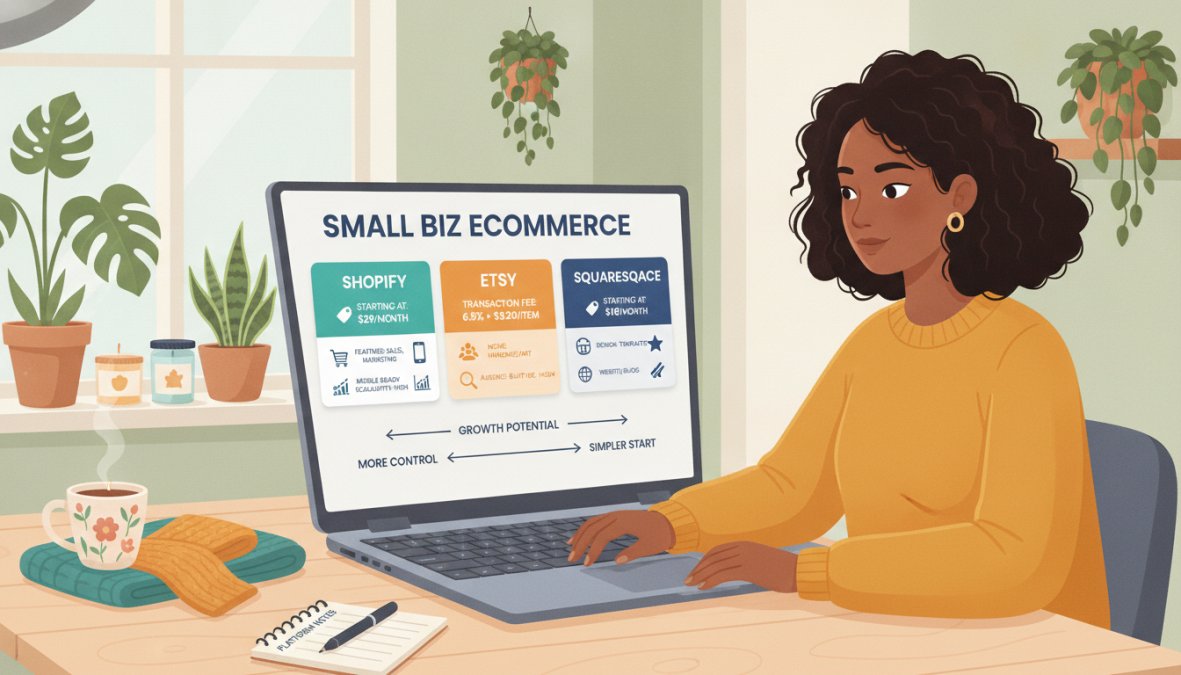
Choosing the right eCommerce platform shapes everything from your conversion rate to your monthly overhead. The best platform depends on your product type, technical comfort level, and growth goals.
Platform Comparison: Fees, Features, and Scalability
| Platform | Monthly Cost | Transaction Fee | Best For | Scalability |
|---|---|---|---|---|
| Shopify | From $39/mo | 0-2% | Brand-focused stores | High |
| Etsy | Free to list | 6.5% + listing fee | Handmade/vintage | Medium |
| WooCommerce | Free (hosting extra) | None | Tech-savvy sellers | High |
| Wix | From $17/mo | None | Simple storefronts | Medium |
| Squarespace | From $23/mo | None | Design-led brands | Medium |
| Amazon | From $39.99/mo | 8-15% | High-volume products | Very High |
Etsy is the fastest way to reach buyers for handmade or unique products because the marketplace brings built-in traffic. Shopify gives you more control over brand identity but requires you to drive your own traffic. WooCommerce is the right call if you already have a WordPress site and want to avoid monthly platform fees.
The trap most sellers fall into is treating their online store as their only sales channel. Buyers are on Google Shopping, Instagram, Facebook, Pinterest, and multiple marketplaces simultaneously. Embed360 changes the equation by syncing your product listings, pricing, inventory, and images across WordPress, Shopify, Wix, Squarespace, Facebook, Instagram, and Google Shopping in real time, so you can sell everywhere without managing everything manually.
Setting Pricing Strategies, Fees, and Profit Margins
Pricing is where most new sellers make a costly miscalculation, pricing based on what feels fair rather than what the math supports.
Understanding Insertion Fees, Final Value Fees, and Hidden Costs
Every platform takes a cut. On Etsy, you pay a $0.20 insertion fee per listing plus a 6.5% transaction fee on the sale price including shipping. On Amazon, final value fees range from 8% to 15% depending on category. Shopify charges no transaction fee if you use Shopify Payments, but 2% if you use a third-party gateway.
The formula every seller should use before setting a price:
Minimum Viable Price = (Cost of Goods + Shipping + Platform Fees + Packaging) ÷ (1 – Target Margin %)
For example: if your product costs $8 to make, shipping costs $4, platform fees average 10%, and you want a 40% margin, your minimum price is approximately $28.
Bootstrapping vs. Taking on Funding to Launch
Most successful small online sellers bootstrap, funding operations from personal savings or early revenue. Bootstrapping works well when your product has low upfront inventory costs and you can test demand with a small batch before scaling. Taking on funding makes sense when you have validated demand, proven unit economics, and need inventory to meet growth.
According to the U.S. Small Business Administration’s guidance on small business funding, most product-based small businesses start with under $10,000 in initial capital. Bootstrapping forces discipline that external funding often removes.
Price your products using real math before you list a single item. Platform fees, shipping, and packaging costs routinely add 25-35% to your true cost of goods, which destroys margins if you price by gut feeling.
Creating High-Quality Product Listings That Convert
A product listing is a sales page. Every element, from the title to the last photo, either builds or breaks buyer confidence.
Writing Titles and Descriptions That Rank and Sell
Product titles serve two masters: the search algorithm and the human buyer. A strong title structure for most platforms: [Primary Keyword] + [Material or Key Feature] + [Use Case or Audience] + [Differentiator]
Example: "Sterling Silver Minimalist Ring, Non-Tarnish, Everyday Wear, Adjustable Band"
For descriptions, lead with the benefit, not the feature. "Made from 925 sterling silver" is a feature. "Stays bright for years without polishing" is the benefit that feature delivers. Your first image is your conversion rate, a crisp, well-lit photo on a clean background outperforms a cluttered lifestyle shot for click-through rate on most platforms. If you sell on Etsy and want to scale listings without spending hours rewriting each one, Embed360’s Listings Genie uses AI to craft optimized titles and descriptions at scale, genuinely useful when you have 50+ products to manage.
Managing Inventory, Fulfillment, and Multi-Channel Sync
Inventory management is invisible when it works and catastrophic when it does not.
Multi-Channel Inventory Synchronization: Avoiding Overselling
Overselling, listing a product as available on multiple channels when you only have one unit in stock, is one of the fastest ways to earn negative reviews and account warnings. A seller with 3 units listed on Etsy, their Shopify store, and Instagram simultaneously risks selling the same unit three times. The manual workaround of logging into each platform after every sale is unsustainable at any meaningful volume.
According to Statista’s 2025 eCommerce market overview, multi-channel retail continues to grow as buyers increasingly discover products across social media, search, and marketplaces before purchasing. Embed360 handles real-time inventory synchronization across all connected channels automatically, when you update a listing, price, or stock level, every channel reflects the change instantly. You can also display your Etsy listings directly on your own website using the Etsy Embed feature, keeping everything in sync without rebuilding your catalog.
Fulfillment options to evaluate:
- Self-fulfillment: Best for low volume, handmade, or fragile products requiring custom packaging
- Third-party logistics (3PL): Best for sellers shipping 50+ orders per month who want to reclaim time
- Dropshipping fulfillment: Best for testing demand without holding inventory
Legal Requirements for Selling Online: Tax, Compliance, and Licensing
This is the section most beginner guides skip entirely. It is also the section that can cost you the most if you ignore it.
Sales Tax Nexus: What Online Sellers Must Know
Sales tax nexus is the legal connection between a seller and a state that creates an obligation to collect and remit sales tax there. The Supreme Court’s South Dakota v. Wayfair decision changed the rules permanently: most states now have economic nexus laws requiring you to collect and remit sales tax once you exceed a threshold (commonly $100,000 in sales or 200 transactions), even if you have never set foot in that state.
What online sellers need to do:
- Register for a sales tax permit in your home state before your first sale
- Track sales by state to identify when you cross economic nexus thresholds
- Use a tax automation tool (TaxJar, Avalara) once you sell in multiple states
- Understand that some platforms (Etsy, Amazon) collect and remit marketplace facilitator taxes on your behalf in many states, but not all
Beyond sales tax, check whether your product category requires additional licensing, food products, cosmetics, and supplements carry federal and state regulatory requirements that a standard business license does not cover. The IRS guidance on business taxes for online sellers is a useful starting point for understanding your federal obligations.
Ignoring sales tax nexus is not a victimless oversight. State tax authorities have become significantly more aggressive in auditing online sellers since 2018. Back taxes, penalties, and interest can exceed the original tax owed.
eCommerce Marketing Strategies for Beginners
Getting your store live is step one. Getting buyers to find it is the actual challenge, and it is where most new sellers underinvest.

Customer Acquisition: SEO, Social Media, and Google Shopping
Search engine optimization (SEO) for product listings means using the exact words buyers type into search bars as your titles, tags, and descriptions. Research keywords using the platform’s own search bar, autocomplete suggestions are real searches from real buyers.
Google Shopping is an underused channel for small sellers. Submit a product feed to Google Merchant Center and your products appear in shopping results when buyers search for them. Embed360 pushes automatic feed updates to Google Shopping as part of its sync process.
Social media works differently than SEO. A practical approach for beginners: post 3-4 times per week mixing product content (30%), behind-the-scenes content (40%), and social proof/reviews (30%). Know your customer acquisition cost (CAC) before scaling paid traffic, if you spend $50 on ads and get 5 sales, your CAC is $10. If your average order value is $15 and your product cost is $8, you are losing money on every acquired customer.
Post-Purchase Customer Retention That Drives Repeat Sales
The customer you already have is significantly cheaper to sell to again than a new customer. A confirmation email with a personal note or small discount code costs nothing and meaningfully increases repeat purchase probability.
Retention tactics that work for product sellers:
- Email sequences: A 3-email post-purchase sequence (confirmation, shipping update, review follow-up) builds relationship and drives reviews simultaneously
- Loyalty incentives: A simple "buy 3, get 10% off your next order" structure increases order frequency without heavy discounting
- Re-engagement campaigns: Customers who have not purchased in 90 days respond well to a "we miss you" email with a time-limited offer
Performance metrics to track for retention:
- Repeat purchase rate: What percentage of customers buy more than once?
- Customer lifetime value (CLV): Total revenue generated by a customer across all purchases
- Review rate: What percentage of buyers leave a review?
Increasing your repeat purchase rate by even a small margin has a larger impact on profitability than acquiring new customers, because the cost of retention is a fraction of the cost of acquisition.
Selling online successfully comes down to three things: choosing the right products for a defined audience, building a presence across multiple channels, and managing operations without burning out on manual work. Multi-channel selling is where most growing sellers hit a wall, managing listings, inventory, and pricing across Etsy, Shopify, social media, and Google Shopping manually is unsustainable. Embed360 solves that problem directly: real-time syncing across all channels, AI-powered listing optimization, and one-click setup for Facebook and Instagram shops mean you spend less time on admin and more time growing. Create a free account at Embed360 and start selling everywhere your buyers already are.
Frequently Asked Questions
What is the easiest way to start selling products online?
The easiest way to sell products online is to start on an established online marketplace like Etsy, eBay, or Amazon, where traffic already exists. Once you gain traction, expand to your own online store using platforms like Shopify or Wix. Tools like Embed360 can help you sync your listings across multiple channels automatically, so you are not managing each platform separately. Start with a small product range, validate demand, then scale.
Do I need a business license to sell products online?
In most regions, you will need at least a basic business license to sell products online legally, especially if you are operating as a business rather than an occasional seller. Requirements vary by location, but you should also register for sales tax collection if you meet economic nexus thresholds in certain states or countries. It is advisable to consult a local accountant or legal professional to confirm the specific legal requirements for selling online in your area.
How much does it cost to start an online store?
Startup costs for an online store vary widely depending on your chosen eCommerce platform and business model. Marketplace selling on Etsy or eBay can start with minimal upfront cost, though insertion fees and final value fees apply per sale. Building your own online store on Shopify or Wix typically involves a monthly subscription. Factor in product sourcing, packaging, shipping logistics, and marketing when calculating your total budget. Many sellers start by bootstrapping with a small product inventory to test the market first.
What are the best platforms for selling products online for small businesses?
The best eCommerce platforms for small business sellers include Shopify for scalability, Etsy for handmade or niche products, Wix and Squarespace for design flexibility, and WooCommerce for WordPress users. Each has different fee structures, built-in audiences, and features. If you are already selling on Etsy, platforms like Embed360 let you expand to multiple channels, including WordPress, Shopify, Facebook, Instagram, and Google Shopping, without manually managing separate listings for each.
How do I handle shipping and fulfillment for online sales?
Shipping and fulfillment for online sales can be managed in-house or outsourced to a third-party fulfillment provider. Start by researching carrier rates and offering calculated shipping at checkout to protect your profit margins. Clearly communicate processing times in your product listings. As you scale, consider fulfillment services that handle picking, packing, and shipping on your behalf. Accurate inventory management is critical, multi-channel sellers should use synchronization tools to prevent overselling across platforms.
How do I find profitable products to sell online?
To find profitable products to sell online, start with market research: browse best sellers lists on major marketplaces, use keyword tools to gauge search demand, and look for niches where competition is manageable but buyer intent is strong. Evaluate profit margins carefully by accounting for product sourcing costs, platform fees, shipping logistics, and marketing spend. Validate your ideas by testing a small batch before committing to large inventory purchases, whether you are using dropshipping, wholesale, or producing your own goods.
