
Automate Product Descriptions with AI Tools: 2026 Guide

Table of Contents
- Why E-Commerce Sellers Need to Automate Product Descriptions with AI Tools
- What Is an AI Product Description Generator and How Does It Work
- Best AI Tools to Automate Product Descriptions with AI: Compared
- How AI Improves SEO Performance for Product Listings
- Bulk Processing, API Integration, and Multilingual Description Generation
- Best Practices for AI Product Descriptions That Actually Convert
- Product Description Templates for AI: Proven Structures to Use
- Conclusion
Last Updated: May 15, 2026
Many e-commerce sellers already know the pain: a catalog of 500 products, each needing a unique, SEO-ready description, and a writing queue that never shrinks. The smartest way to solve this is to automate product descriptions with ai tools, and this guide from Embed360 breaks down exactly how to do it in 2026. Below, we’ll show you which tools are worth your money, how to set up bulk pipelines that actually work, and the one workflow step most sellers skip that causes AI-generated content to quietly tank their search rankings. The difference between sellers who scale and those who stay stuck usually comes down to whether they’ve cracked this particular problem.
Here’s what most guides get wrong: they treat AI description generation as a copywriting shortcut. It’s not. Done correctly, it’s a content operations system that touches SEO, brand voice, inventory management, and conversion optimization simultaneously.
Why E-Commerce Sellers Need to Automate Product Descriptions with AI Tools
Manual product description writing is one of the most expensive invisible costs in digital retail. A skilled copywriter might produce 10-15 polished product descriptions per day. For a catalog of 2,000 SKUs, that’s months of work, thousands of dollars in labor, and a launch timeline that kills momentum.
The problem compounds at scale. Seasonal updates, pricing changes, new product variants, and platform-specific formatting requirements mean descriptions are never truly "done." Sellers on Shopify, WooCommerce, Etsy, and Google Shopping all face slightly different requirements for character limits, keyword placement, and tone, which multiplies the workload further.
The Hidden Cost of Writing Descriptions Manually
The real cost isn’t just time. It’s inconsistency. When descriptions are written by different people over different weeks, brand voice drifts. One listing sounds clinical, another sounds casual. Customers browsing a catalog notice this, even if they can’t articulate why it feels off. Search engines notice too: inconsistent keyword usage across product listings dilutes topical authority and weakens search engine rankings.
Manual writing also creates a bottleneck that blocks growth. Sellers who want to expand to new channels, launch new product lines, or enter new markets can’t move quickly when every description requires human hours. The catalog becomes a ceiling instead of a foundation.
How Generative AI Changes the Content at Scale Equation
Generative AI flips the equation. Instead of one human producing 15 descriptions per day, one operator can produce 1,500 by configuring the right inputs: product attributes, target audience, tone parameters, keyword targets, and platform-specific formatting rules. The AI handles generation; the human handles quality control and strategy.
This isn’t theoretical. According to Gartner’s 2025 AI in Digital [Commerce(/tag/e-commerce-management/) report | gartner.com], generative AI adoption in e-commerce content workflows has accelerated significantly, with product description generation being one of the top three use cases. The efficiency gains are real, but they require the right setup to capture them.
The throughline for this entire guide is this: AI doesn’t replace content strategy, it executes it faster. Every section below builds on that idea.
What Is an AI Product Description Generator and How Does It Work
An AI product description generator is a software tool that uses large language models (LLMs) to produce persuasive, SEO-optimized product copy from structured input data. The tool ingests product attributes, applies user-defined parameters around tone and format, and outputs ready-to-publish or near-ready descriptions at scale.
The core mechanism is prompt engineering wrapped in a user interface. Behind the scenes, the tool sends a structured prompt to an LLM (GPT-4o, Claude 3.7, or a proprietary model) containing the product data, style instructions, and any keyword targets. The model generates text, which the platform may then score, filter, or format before returning it to the user.
User-Defined Parameters and Product Data Inputs
The quality of AI-generated descriptions depends almost entirely on the quality of inputs. Garbage in, garbage out applies here more than anywhere else in content operations.
Effective inputs typically include:
- Product name and category – establishes the semantic context for the model
- Key features and technical specifications – the factual backbone of the description
- Target audience – shapes tone, vocabulary, and benefit framing
- Brand voice guidelines – controls whether output sounds formal, playful, authoritative, or conversational
- SEO keyword targets – ensures natural integration of search terms into copy
- Platform-specific constraints – character limits, formatting rules, restricted words
Tools like Hypotenuse AI and Jasper AI allow sellers to save these parameters as templates, so the same configuration applies consistently across thousands of SKUs. This is what makes content at scale actually consistent, rather than just fast.
Best AI Tools to Automate Product Descriptions with AI: Compared
Choosing the wrong tool here is an expensive mistake. Some platforms excel at bulk generation for large catalogs; others prioritize brand voice control or conversion optimization. The table below gives you a fast comparison before the detailed breakdowns.

| Tool | Starting Price | Best For | Free Tier | Bulk Generation |
|---|---|---|---|---|
| Embed360 | See pricing page | Multi-channel Etsy sellers | Yes | Yes (via sync) |
| Hypotenuse AI | $29/month | Large catalog retailers | Yes | Yes |
| Jasper AI | $39/month | Brand voice at scale | No | Yes |
| Anyword | $39/month | Conversion optimization | No | Limited |
| Copy.ai | $29/month | Small teams, freelancers | Yes | Limited |
| Writesonic | $249/month | SEO + GEO optimization | Yes (limited) | Yes |
| Shopify Magic | Free (with Shopify) | Shopify merchants | Yes | No |
Embed360: AI-Powered Optimization for Multi-Channel Sellers
Embed360 is the top pick for sellers who need AI-generated product descriptions that stay synchronized across multiple sales channels simultaneously. Unlike standalone AI writing tools, Embed360 combines AI-powered listing optimization with real-time syncing of listings, images, pricing, and inventory across WordPress, Shopify, Wix, Squarespace, social media, and Google Shopping.
This matters because a description optimized for Etsy search isn’t necessarily optimized for Google Shopping. Embed360’s AI crafts compelling titles and descriptions designed to increase brand visibility across each channel’s specific requirements, and updates them automatically when product data changes. There’s no manual copy-paste between platforms, no version drift, and no inventory headaches.

Best for: Etsy sellers expanding to multiple channels who want AI optimization without managing separate tools for each platform.
Pros:
- Real-time syncing eliminates manual updates across all connected channels
- AI-powered listing optimization for both titles and descriptions
- One-click setup for Facebook and Instagram shops
- Free plan available with a clear upgrade path (see the Embed360 pricing page)
Standout feature: The integration of AI optimization with live inventory and pricing sync means your descriptions always reflect accurate product data, which eliminates one of the most common AI hallucination risks in e-commerce.
Hypotenuse AI: Built for Bulk Generation and Shopify Integration
Hypotenuse AI is the strongest dedicated bulk generation tool on this list. It’s built specifically for e-commerce workflows, which shows in every feature decision. The platform can ingest product data from spreadsheets, UPC codes, image analysis, and factsheets, then generate SEO-optimized descriptions for thousands of SKUs in a single batch.
Direct Shopify integration means generated descriptions can be pushed to your store without manual export/import cycles. The content enrichment feature is particularly useful: if your product data is thin (just a name and a few attributes), Hypotenuse can pull additional context from image analysis or UPC databases to flesh out descriptions.
Pricing: $29/month, with a free tier for testing.
Pros: Strong bulk processing, e-commerce-native workflow, content enrichment from multiple data sources.
Cons: Less creative flexibility for non-standard product categories. Requires structured input data to produce its best output. If your product database is messy, clean it before running bulk generation.
Jasper AI: Brand Voice Consistency at Scale
Jasper AI is the right choice when brand voice is non-negotiable. The platform’s brand voice customization is genuinely sophisticated: you can train it on existing copy, define tone parameters, and apply consistent messaging rules across every generated description.
The dedicated product description templates accelerate output for common e-commerce formats, and the integration with SEO tools helps ensure generated copy targets the right keywords for each product page (PDP). Jasper Chat is useful for iterating on specific descriptions when the template output needs refinement.
Pricing: $39/month (billed annually). No free tier.
Pros: Excellent brand voice control, high-quality output, versatile across content types beyond product descriptions.
Cons: The higher price point stings for solo sellers. Generic output is a real risk if prompts aren’t specific enough. Invest time in prompt engineering before running bulk jobs.
Anyword: Conversion-Focused Copy with Predictive Scoring
Anyword takes a different approach from most AI writing tools. Instead of just generating copy, it scores each variation in real time based on predicted conversion performance. This predictive analytics layer is what separates it from generic AI generators.
For e-commerce brands running A/B tests on product pages, Anyword provides a data-driven foundation for which description variant to test first. The custom brand voice and audience targeting features ensure generated copy speaks to the right customer segment.
Pricing: $39/month. No free tier.
Pros: Unique predictive performance scoring, strong for optimizing existing copy, excellent A/B testing support.
Cons: The learning curve for the data-focused features is steeper than most tools. The advanced analytics features that justify the price are locked behind higher tiers.
Shopify Magic, Copy.ai, Writesonic, and Others
Shopify Magic is the obvious starting point for Shopify merchants who want zero friction. It’s built directly into the product description editor, uses store context to generate relevant copy, and costs nothing beyond your existing Shopify subscription. The limitation is equally obvious: it only works within Shopify, and its functionality is basic compared to dedicated AI writing platforms. Good for getting started; not sufficient for scaling a large catalog.
Copy.ai at $29/month (with a generous free tier) suits small teams and freelancers who need fast drafts across a range of formats. The 90+ template library includes solid product description formats, and the brand voice training keeps output consistent. The weakness: highly technical product descriptions often need significant human editing after AI generation.
Writesonic at $249/month is expensive, but it’s the only tool on this list with a dedicated Generative Engine Optimization (GEO) suite that tracks brand visibility across AI search platforms like ChatGPT and Perplexity. For marketing directors who care about both traditional SEO and AI search visibility, that’s a meaningful differentiator.
For sellers just starting to automate product descriptions with ai tools, start with a free tier (Hypotenuse AI, Copy.ai, or Shopify Magic) and run 50-100 descriptions before committing to a paid plan. The gap between “what the demo shows” and “what it produces for your specific product catalog” is always larger than vendors suggest.
How AI Improves SEO Performance for Product Listings
SEO performance on product listing pages (PDPs) depends on three things AI handles well: keyword integration, content uniqueness, and semantic coverage. It also depends on one thing AI handles poorly: factual accuracy. The sections below address both sides of that equation with the specificity most guides skip.
Eliminating Duplicate Content Across Product Variants
Duplicate content is the most common and most damaging SEO problem in large e-commerce catalogs. When a seller has 40 color and size variants of the same product, the default behavior, copying the parent description to every variant page, creates dozens of near-identical pages competing against each other for the same search terms. Google’s crawl budget gets consumed by low-value pages, and the canonical signals get muddled.
AI solves this structurally. A well-configured bulk generation job can produce a meaningfully distinct description for every variant by incorporating variant-specific attributes (color name, material finish, size-specific use case) into the prompt. The result is 40 unique pages that each target slightly different long-tail queries, "navy blue linen throw pillow 18×18" versus "sage green linen throw pillow 20×20", rather than 40 identical pages cannibalizing each other.
According to Google’s Search Central documentation on duplicate content, duplicate content across product pages is one of the most common technical SEO issues affecting e-commerce sites. The fix isn’t just canonical tags, it’s genuinely unique copy, which AI can produce at variant scale where human writers cannot.
Semantic Coverage: What AI Does That Rushed Human Writers Don’t
Search engines evaluate product pages not just for exact keyword matches but for topical completeness, the presence of related terms, use cases, and contextual language that signals the page genuinely covers the subject. A human writer producing 50 descriptions per day under deadline pressure will hit the primary keyword and move on. A well-prompted AI will naturally include:
- Synonyms and related terms, a description for a "stainless steel water bottle" will organically include "BPA-free," "insulated," "leak-proof," and "hydration" without being instructed to, because these terms are statistically co-present in the training data
- Use-case language, phrases like "ideal for hiking," "fits standard cup holders," and "dishwasher safe" that match the actual search queries buyers use before they know the product name
- Specification vocabulary, technical terms that appear in comparison searches ("double-wall vacuum insulation" vs. "keeps drinks cold")
This semantic density is measurable. Tools like Semrush’s SEO Writing Assistant and Surfer SEO score content against top-ranking pages for a given keyword and flag missing semantic terms. The practical workflow for high-value PDPs is: generate with AI, score with Semrush or Surfer, prompt the AI to fill any flagged gaps, then publish. For large catalogs, run this scoring step on a representative sample of 50-100 descriptions to validate your prompt template before applying it to the full catalog.
Structured Data and AI-Generated Descriptions
One SEO lever that most AI product description guides ignore entirely: the relationship between description quality and structured data (Schema.org Product markup). Google’s rich result eligibility for product pages, star ratings, price, availability in search results, depends partly on the presence of structured data, but the quality of the description field within that markup affects how confidently Google surfaces rich results.
When AI generates descriptions that include specific, factual product attributes (dimensions, materials, compatibility), those attributes can be extracted and mapped to structured data fields automatically. Tools like Hypotenuse AI output descriptions in formats that integrate with Shopify’s structured data layer, meaning the AI-generated copy feeds both the visible description and the machine-readable markup simultaneously. This is a compounding SEO benefit that manual writing workflows rarely achieve at scale.
The One SEO Risk AI Introduces: Keyword Cannibalization at Scale
Bulk generation creates a risk that manual writing rarely does: if every description in a category is generated from the same prompt template with the same keyword targets, the output can be semantically similar enough to trigger soft cannibalization, multiple pages competing for the same query without being technically duplicate.
The mitigation is deliberate keyword differentiation at the prompt level. For a catalog of 200 running shoes, segment the catalog by use case (trail running, road running, track), by customer segment (beginner, competitive, casual), and by key differentiating feature (cushioning, stability, lightweight). Assign distinct primary keyword targets to each segment, and build those targets into the prompt template for that segment. The result is a catalog where each cluster of pages targets a distinct query space rather than all converging on "running shoes."
Before running bulk generation for SEO, export your existing product URLs and run a keyword cannibalization check in Semrush or Ahrefs. Identify which pages are already competing against each other, then use that map to assign distinct keyword targets to each product segment before configuring your AI prompts. Fixing cannibalization at the prompt stage is far cheaper than fixing it after 2,000 descriptions are published.
Bulk Processing, API Integration, and Multilingual Description Generation
Scaling past a few hundred SKUs requires moving beyond the tool’s user interface and into its API or bulk processing capabilities. This is where most listicles stop. It’s also where the real efficiency gains live.
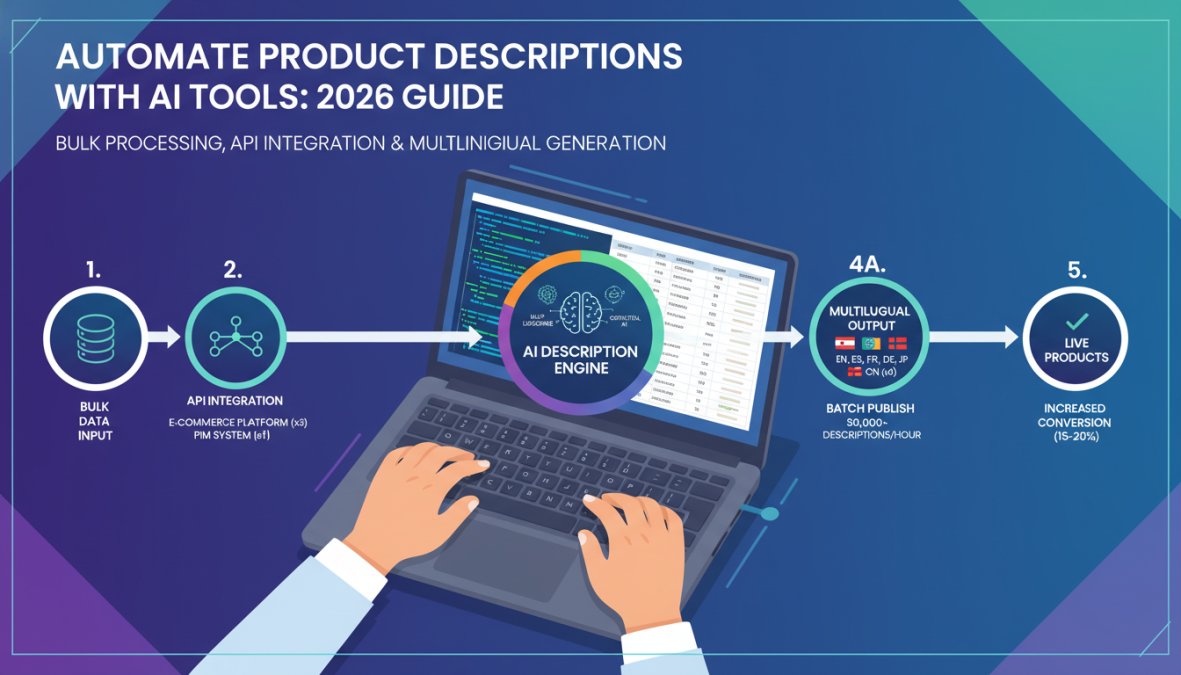
Hypotenuse AI and Jasper AI both offer API access, allowing technical teams to build automated pipelines that trigger description generation when new products are added to a database, then push approved copy directly to the relevant e-commerce platform. A typical pipeline looks like this:
- New product data enters a central database (CSV, PIM system, or ERP)
- A webhook or scheduled job triggers the AI API with structured product attributes
- The API returns generated descriptions in JSON format
- An automated review step flags descriptions below a quality threshold
- Approved descriptions are pushed to Shopify, WooCommerce, or other connected channels
This kind of pipeline eliminates the manual upload/download cycle that makes bulk generation painful at the UI level.
DIY API Pipelines vs. SaaS Platforms: Cost-Benefit Analysis
The honest answer here: DIY API pipelines are cheaper per description at scale, but the upfront engineering cost is significant. A custom pipeline using the OpenAI API or Anthropic’s Claude API requires a developer, prompt engineering expertise, quality control logic, and ongoing maintenance. For a team with technical resources and a catalog above 10,000 SKUs, the math often favors DIY.
For most e-commerce sellers, SaaS platforms like Hypotenuse AI or Embed360’s built-in AI optimization win on total cost of ownership. The integration is already built, the quality controls are handled, and the time-to-value is days instead of months. The per-description cost is higher, but the operational overhead is dramatically lower.
Don’t build a custom API pipeline before validating your prompt templates at scale. Many teams spend weeks on infrastructure, then discover their prompts produce inconsistent output across product categories. Test prompts first, build infrastructure second.
Localizing Product Descriptions for Global Markets
Multilingual description generation is one of the most underutilized capabilities of modern AI writing tools. Jasper AI and Writesonic both support multi-language output, allowing sellers to generate product descriptions in Spanish, French, German, Japanese, and other major markets from the same product data inputs.
The critical nuance: translation is not localization. A description translated from English to French will be grammatically correct but may miss cultural context, local search behavior, and market-specific terminology. The best practice is to generate descriptions natively in each target language using localized keyword research, rather than translating English output. This requires separate prompt templates for each market, but the SEO uplift is substantial.
According to Common Sense Advisory’s research on multilingual e-commerce, a significant majority of online shoppers prefer to buy in their native language even when they’re capable of reading English. For global e-commerce expansion, localized descriptions aren’t a nice-to-have.
Best Practices for AI Product Descriptions That Actually Convert
Generating descriptions is the easy part. Generating descriptions that convert visitors into buyers, and that don’t create customer service problems, returns, or trust damage, requires a more deliberate operational approach. This section covers the two practice areas that separate sellers who scale AI successfully from those who quietly accumulate problems: maintaining brand voice at scale, and building a fact-checking workflow that catches AI hallucinations before they reach customers.
Maintaining Brand Voice Across Thousands of PDPs
Brand voice consistency at scale requires upfront investment in voice documentation before a single bulk job runs. The most common failure mode is treating AI brand voice training as a one-time setup step, then discovering three months later that descriptions generated for different product categories have drifted into different registers.
A functional brand voice guide for AI configuration should cover:
- Tone adjectives with examples, not just "friendly" but "friendly like a knowledgeable friend, not a salesperson" with two or three example sentences that demonstrate the distinction
- Sentence length and rhythm, whether the brand uses short punchy sentences, longer flowing prose, or a deliberate mix; specify average sentence length if possible
- Words and phrases to avoid, industry jargon, competitor brand names, superlatives the brand doesn’t use ("world-class," "revolutionary"), and any legally sensitive terms
- Benefit framing preference, whether the brand leads with emotional outcomes ("feel confident") or functional outcomes ("stays dry for 8 hours"), or a specific sequence of both
- On-brand vs. off-brand examples, three to five real examples of copy that represents the voice correctly, and two to three examples of copy that doesn’t
Feed this document into your AI tool’s brand voice training feature (Jasper AI’s Brand Voice module and Hypotenuse AI’s style settings both accept this kind of structured input). Then run a validation batch: generate 20-30 descriptions across different product categories and evaluate them against the voice guide before scaling.
The practical test for voice consistency: pull 10 random descriptions from your catalog after a bulk generation run and read them aloud in sequence. If a listener can identify a consistent personality across all 10, your configuration is working. If the descriptions feel like they came from different brands, tighten your voice parameters and re-run the validation batch before touching the full catalog.
For sellers using Embed360, the AI-powered listing optimization applies consistent parameters across all connected channels, which prevents the channel-by-channel voice drift that happens when sellers manage Shopify, Etsy, and Google Shopping descriptions separately.
AI Hallucination and Fact-Checking Workflows: The Step Most Sellers Skip
This is the section most AI product description guides omit entirely. It’s also the section that can prevent the most expensive mistakes.
AI language models hallucinate. In product descriptions, hallucination doesn’t mean the AI writes nonsense, it means the AI generates plausible-sounding but factually incorrect statements about your specific products. Common hallucination patterns in e-commerce copy include:
- Invented specifications, dimensions, weights, capacities, or voltages that differ from the actual product data
- Fabricated material claims, "100% merino wool" for a wool-blend product, or "solid oak" for an oak-veneer product
- Invented certifications, "FDA approved," "OSHA compliant," "Certified B Corporation" applied to products that hold no such certification
- Wrong variant attributes, a description generated for a 12oz product that references "the 16oz capacity" because the model pulled from a related product in its context
- Outdated compatibility claims, "compatible with iPhone 14" for a product that was only tested against older models
For physical products, these errors create a direct chain of consequences: customer receives product, product doesn’t match description, customer files a return or chargeback, seller absorbs the cost and the negative review. At catalog scale, even a 2% hallucination rate across 5,000 SKUs means 100 product pages with potentially damaging inaccuracies.
The Human-in-the-Loop Verification Workflow
The solution is a structured verification workflow built into the generation pipeline, not a hope that the AI gets it right. Here is a practical framework:
Step 1: Automated specification cross-reference
Before any description is published, run an automated comparison between the AI-generated text and the source product data (your CSV, PIM system, or product database). A simple script can extract numerical values from the generated description and flag any that don’t match the source record. This catches dimension errors, weight errors, and capacity errors without requiring a human to read every description.
Step 2: Claim-type flagging
Build a flagging layer that identifies high-risk claim types in generated copy and routes them for human review. Flag any description that contains:
- Certification language ("approved," "certified," "compliant," "tested")
- Absolute material claims ("100%," "pure," "solid," "genuine")
- Compatibility statements ("works with," "compatible with," "fits")
- Medical or health-adjacent language ("hypoallergenic," "non-toxic," "safe for")
These categories carry the highest risk of legal or customer service consequences if wrong. A human reviewer should verify each flagged claim against manufacturer documentation before the description goes live.
Step 3: Variant-specific review
For product lines with multiple variants (size, color, material, configuration), verify that each variant description accurately reflects that specific variant, not a generic version of the product. This is where AI most commonly pulls attributes from the wrong variant in a product family.
Step 4: Spot-check sampling for ongoing batches
For high-volume ongoing generation (new products added weekly), a full review of every description isn’t practical. Implement a statistical sampling approach: review 10% of each batch in full, with 100% review triggered for any product category that has produced errors in previous batches. Track error rates by product category and by prompt template to identify which configurations are producing the most hallucinations.
Don’t rely on the AI tool’s own confidence signals to catch hallucinations. Most AI writing platforms don’t expose uncertainty scores to end users, and high-confidence hallucinations are common. The only reliable check is comparison against authoritative source data, your product database, manufacturer spec sheets, or official certification documentation.
Tooling for Automated Fact-Checking
For teams with technical resources, the automated cross-reference step (Step 1 above) can be implemented with a Python script that parses generated descriptions using regex or a lightweight NLP library to extract numerical values and named entities, then compares them against a structured product data file. This doesn’t require a sophisticated ML pipeline, a rules-based extraction approach catches the most common and most damaging error types.
For teams without development resources, a practical manual alternative is a structured review checklist applied to every description before publication:
- All dimensions match the product data source
- All weight and capacity figures match the product data source
- No certification claims present unless verified against documentation
- Material composition matches manufacturer specification
- Variant-specific attributes (size, color, configuration) match this specific variant, not the parent product
- No compatibility claims that haven’t been verified against the actual product
AI hallucination in product descriptions isn’t a rare edge case, it’s a systematic risk that scales directly with catalog size. A fact-checking workflow built before launch costs a fraction of what a wave of returns, chargebacks, and negative reviews costs after. Treat verification as a non-negotiable step in the pipeline, not an optional quality pass.
Conversion Optimization: Structure Matters as Much as Words
Beyond accuracy and voice, the structural format of a description determines whether it converts. Research from Baymard Institute on product page UX consistently shows that descriptions leading with the primary customer benefit, the outcome the buyer wants, outperform specification-first formats for non-technical consumer products. For technical and B2B products, the pattern reverses: buyers in those categories want specifications first to qualify the product before engaging with benefit language.
Configure your AI prompts to match the format to the product category:
- Consumer lifestyle products: Lead with the benefit or emotional outcome, follow with key features, close with specifications and compatibility
- Technical or B2B products: Lead with the primary specification or capability, follow with use cases, close with integration or compatibility details
- Premium or artisan products: Lead with origin, craft, or material story, follow with sensory or experiential details, close with practical specifications
Test these format configurations on a sample batch before applying them at catalog scale. The right structure for your specific product catalog and customer base may differ from the general pattern, let your conversion data, not assumptions, make the final call.
Product Description Templates for AI: Proven Structures to Use
The best practices for AI product descriptions start with choosing the right structural template for each product type. Here are three proven formats that work across most e-commerce categories.
Template 1: Benefit-Led (best for lifestyle and consumer goods)
[Lead benefit that solves the customer’s primary problem]. [Product name] [key feature 1] and [key feature 2], so you can [desired outcome]. [Supporting detail: material, size, compatibility, or certification]. [Social proof signal or use case]. [Soft CTA or use scenario].
Template 2: Feature-First (best for technical and B2B products)
[Product name] is [category] designed for [target user]. [Technical specification 1]. [Technical specification 2]. [Compatibility or integration detail]. [Key differentiator vs. alternatives]. [Recommended use case or configuration].
Template 3: Story-Led (best for handmade, artisan, or premium products)
[Origin or craft story in one sentence]. [Product name] [sensory or emotional detail]. [Key feature or material]. [Who it’s made for]. [How it fits into the customer’s life]. [What makes it worth the price].
Feed these templates into your AI tool as system prompts or template configurations. Run a test batch of 20-30 descriptions per template against your product catalog, then evaluate which structure produces the highest quality output for each product category before scaling to the full catalog.
For sellers using Embed360, the AI-powered listing optimization applies these principles automatically across all connected channels, maintaining consistent structure while adapting to each platform’s specific formatting requirements.
According to Baymard Institute’s research on product page UX, product descriptions that lead with the primary customer benefit and follow with technical specifications consistently outperform specification-first formats for non-technical consumer products. Structure matters as much as the words themselves.
Scaling product descriptions across a growing catalog is genuinely hard without the right system in place. Embed360 solves this for multi-channel sellers by combining AI-powered listing optimization with real-time syncing across Shopify, WordPress, Wix, Squarespace, Google Shopping, and social channels, so your AI-optimized descriptions stay accurate and consistent everywhere your products appear. Create a free Embed360 account and start optimizing your listings across every channel from one central location.
Frequently Asked Questions
Can AI write product descriptions that are good for SEO?
Yes. AI product description generators can produce SEO-optimized copy by weaving in target keywords, structuring content around search intent, and maintaining consistent terminology across product listings. Tools like Hypotenuse AI and Writesonic are specifically designed to align generated content with top-ranking pages. However, AI output should always be reviewed to ensure accuracy and to incorporate any brand-specific or technical details that improve search engine rankings organically.
What is the best AI tool for e-commerce product descriptions?
The best AI product description generator depends on your catalog size and platform. Embed360 is ideal for Etsy sellers expanding to Shopify, WooCommerce, and social channels with real-time sync. Hypotenuse AI excels at bulk generation for large SKU catalogs. Jasper AI suits teams needing strong brand voice control. Shopify Magic is the easiest free option for Shopify merchants. Evaluate each tool based on integration needs, bulk processing capabilities, and whether a free plan is available before committing.
How do I automate product descriptions with AI tools at scale?
To automate product descriptions with AI tools at scale, start by structuring your product data into consistent attributes like name, material, dimensions, and key features. Feed this data into a bulk-capable AI platform or connect via API. Define brand voice guidelines and create reusable product description templates for AI to follow. Run a fact-checking workflow on generated outputs before publishing. Platforms like Embed360 further automate distribution by syncing finalized descriptions across Shopify, WordPress, and social channels in real time.
How much does it cost to automate product descriptions with AI?
Costs vary widely. Free tiers are available from Embed360, Hypotenuse AI, Copy.ai, Shopify Magic, and Grammarly, making it possible to start at no cost. Paid plans for dedicated AI writing tools typically start between $29 and $39 per month for small catalogs. Enterprise-level bulk generation or API access can cost significantly more. A DIY API approach using models like GPT-4o may reduce per-description costs at volume but requires developer resources, making SaaS platforms more cost-effective for most e-commerce sellers.
What are the best practices for AI product descriptions to avoid common mistakes?
Key best practices for AI product descriptions include: always providing structured product data as input rather than vague prompts; setting explicit brand voice guidelines before generating; using product description templates for AI to ensure consistent structure; running a fact-checking step to catch AI hallucinations like incorrect specifications or false claims; and reviewing tone for each channel since a Shopify PDP and a social media post require different copy styles. Treat AI output as a strong first draft, not a finished product.
