
How to Optimize Etsy Titles for Google (2026 Guide)

Table of Contents
- Why Optimizing Etsy Titles for Google Is Different From Etsy SEO
- Etsy Title Character Limit: Optimizing for Mobile and Desktop
- Etsy Keyword Research Tools That Surface Google-Friendly Terms
- How to Optimize Etsy Titles for Google: A Step-by-Step Framework
- Ranking vs. Click-Through Rate: Why Both Matter for Etsy Listings
- Etsy SEO Best Practices for Shop Pages, Tags, and Metadata
- Common Mistakes Etsy Sellers Make When Targeting Google Search
- Conclusion
Last Updated: May 15, 2026
Etsy listings appear in Google search results far more often than most sellers realize, yet the title strategies that work inside Etsy’s marketplace frequently underperform in organic search. Knowing how to optimize Etsy titles for Google is a distinct skill from Etsy SEO, and this guide from Embed360 breaks down exactly where the two diverge and how to bridge the gap. Below, you’ll find a step-by-step framework covering keyword research, title structure, character limits, duplicate title risks, and the CTR factors that most guides ignore entirely.
Here’s what most sellers get wrong from the start: they write titles for Etsy’s autocomplete and stop there. Google’s crawler reads your listing title as page title metadata. Those are not the same optimization problem.
Why Optimizing Etsy Titles for Google Is Different From Etsy SEO
Etsy SEO and Google SEO share vocabulary but not logic. Etsy’s internal algorithm weighs recency, conversion history, and listing completeness heavily. Google’s algorithm evaluates topical authority, page metadata, inbound signals, and search intent alignment. A title optimized purely for Etsy’s ranking factors can actively hurt your Google visibility.
Etsy SEO is the practice of optimizing listings to rank within Etsy’s own marketplace search engine, where buyer behavior data and sales velocity carry significant weight.
Google SEO for Etsy listings is the practice of structuring listing titles and metadata so Google’s crawler can index, categorize, and rank those pages in organic search results.
The practical difference matters immediately. Etsy rewards keyword-dense titles because its search parses every word. Google rewards titles that match natural language search queries and signal clear topical relevance within roughly 60 characters.
How Etsy’s Algorithm Works vs. Google’s Search Engine
Etsy’s algorithm prioritizes listings with strong conversion rates, recent sales, completed shop profiles, and keyword relevance across title, tags, and attributes. According to Etsy’s Seller Handbook on search ranking, listing quality score and buyer experience signals directly influence where a product appears in marketplace search.
Google’s search engine operates differently. It crawls the HTML of your Etsy listing page, reads the title tag (which Etsy populates from your listing title), evaluates the page content for topical consistency, and ranks based on relevance to the searcher’s query. Google does not have access to your sales history or Etsy-internal conversion data.
This means a title like “Handmade Ring Sterling Silver Boho Minimalist Stacking Gift Her” might rank well inside Etsy but appears as low-quality metadata to Google because it lacks natural language structure.
Search Intent: What Shoppers Type on Google vs. Etsy
Etsy shoppers type short, categorical queries: “boho silver ring,” “minimalist stacking ring.” Google shoppers type longer, more specific queries: “handmade sterling silver stacking ring for women” or “minimalist boho ring gift for her birthday.” These are long-tail keywords with clear buyer intent, and they map directly to how Google’s algorithm evaluates search queries against page content.
The implication: your Etsy title needs to satisfy both systems simultaneously. That requires a deliberate structure, not keyword cramming.
Etsy Title Character Limit: Optimizing for Mobile and Desktop
Etsy allows up to 140 characters in a listing title. Google truncates page titles at approximately 600 pixels of rendered width, which translates to roughly 55-65 characters depending on the letters used. These two limits create a critical optimization window that most sellers ignore.
The first 60 characters of your Etsy title are the most valuable real estate in your entire listing. Google displays those characters in search results. Everything after that is invisible to organic search users unless they click through.
Where Google Truncates Your Title in Search Results
Google’s title truncation is pixel-based, not character-based, which means wider characters like “W” and “M” consume more display space than narrow characters like “i” and “l.” A practical working rule: keep your primary keyword and product descriptor within the first 55 characters to guarantee full display across all devices.
Mobile search results often display even fewer characters than desktop, because screen width is narrower. On a standard mobile viewport, titles frequently truncate around 50 characters. This means your most search-critical information must appear at the very beginning of the title.
Test your title length before publishing. Paste your proposed title into [Google’s SERP preview tool](https://www.serpsim.com) to see exactly how it renders on both mobile and desktop before committing.
The front-load method, covered in the step-by-step section below, directly addresses this constraint. The core idea: your primary keyword goes first, always.
The Negative SEO Impact of Duplicate Titles Across Listings
This is the part most Etsy SEO guides skip entirely. If you sell ten variations of the same product and give each listing an identical or near-identical title, Google treats those pages as duplicate content. Duplicate content signals low editorial value, which suppresses organic rankings across all affected listings.
Google’s crawler identifies pages with similar title tags and similar body content as thin or redundant. Rather than ranking all ten, it typically picks one to index and deprioritizes the rest. The result: you effectively compete against yourself, and none of your listings rank as well as a single, well-differentiated listing would.
The fix is straightforward. Each listing title must include at least one unique, specific differentiator: the color, material variant, size, or use case that makes that product distinct. “Handmade Ceramic Mug – Matte Black 12oz Coffee Cup” and “Handmade Ceramic Mug – Speckled White 16oz Tea Cup” are different enough to avoid duplication penalties. “Handmade Ceramic Mug Pottery Coffee Tea Cup Gift” repeated across ten listings is a duplicate content problem waiting to compound.
Duplicate listing titles are one of the fastest ways to lose Google indexation across your entire shop. If you have a large catalog with similar products, audit your titles before assuming a ranking problem is caused by something else.
Etsy Keyword Research Tools That Surface Google-Friendly Terms
Etsy-specific keyword tools surface what buyers search inside the marketplace. Google-focused tools surface what buyers search in organic search. For sellers who want Google traffic, both data sources are necessary, and neither alone is sufficient.
The most common mistake here is relying exclusively on Etsy autocomplete or Etsy-specific platforms that only show marketplace search volume. Those tools have no visibility into Google’s search query data. The inverse mistake, using only Google tools, produces keywords with real search volume that Etsy’s internal algorithm has never seen enough conversion data to rank competitively.
The goal is a short list of terms that appear in both datasets simultaneously. Those overlapping terms are your highest-priority title targets because they drive traffic from both channels at once.
Tool 1: Google Keyword Planner, How to Use It for Etsy Listings Specifically
Google Keyword Planner is free with a Google Ads account and pulls data directly from Google’s search index. For Etsy sellers, the workflow differs slightly from how e-commerce brands typically use it.
Step-by-step for Etsy keyword research:
- Open Keyword Planner and select “Discover new keywords.”
- Enter your product category as a seed term, for example, “sterling silver ring” or “handmade ceramic mug.”
- Set the location to your primary market (United States if you ship domestically; leave global if you ship internationally).
- Filter results to show only keywords with “Low” or “Medium” competition. High-competition terms are dominated by major retailers and brand advertisers. An independent Etsy shop cannot realistically compete for “silver ring” against Pandora or Kay Jewelers in organic search.
- Sort by monthly search volume and look for long-tail phrases (three or more words) with volume above roughly 100 searches per month. Below that threshold, the traffic ceiling is too low to justify title real estate.
- Export the results and flag every phrase that contains a modifier you can honestly apply to your product: “handmade,” “personalized,” “minimalist,” “vintage-inspired,” “small batch,” or similar qualifiers that major retailers cannot credibly use.
Those flagged phrases are your Google-side candidate list.
Tool 2: Etsy’s Own Search Bar, Extracting Autocomplete Data Systematically
Etsy’s autocomplete reflects actual buyer behavior inside the marketplace. The suggestions that appear are weighted by search frequency and, to some degree, by conversion rate, Etsy surfaces terms that lead to purchases, not just browsing.
To extract autocomplete data systematically:
- Open Etsy’s search bar and type your seed term without pressing Enter.
- Record every autocomplete suggestion that appears. These are real buyer queries.
- Delete the last word of your seed term and retype it with a different modifier to surface new suggestions. For example: type “sterling silver ring” then try “sterling silver ring for,” “sterling silver ring women,” “sterling silver ring minimalist.”
- Repeat this process with your seed term placed mid-phrase: “handmade sterling silver” surfaces different suggestions than “sterling silver handmade.”
This manual process takes 15-20 minutes per product category and produces a list of 20-40 marketplace-validated phrases.
Tool 3: eRank and Marmalead, What They Add and Where They Fall Short
Etsy-specific platforms like eRank and Marmalead provide estimated search volume, competition scores, and trend data for Etsy marketplace queries. Both tools are useful for validating whether a term has meaningful Etsy search activity before you commit it to a title.
What they add:
- Etsy-specific search volume estimates (not Google volume)
- Competition level within Etsy’s marketplace
- Trend data showing whether a term is growing or declining in Etsy searches
- Listing audit features that flag missing tags, weak titles, and incomplete attributes
Where they fall short:
- Neither tool has access to Google’s search index. A term that scores well in eRank may have negligible Google search volume.
- Their competition scores reflect Etsy listing density, not Google SERP difficulty. A term with “low competition” in eRank may be dominated by major retailers in Google’s results.
Use these tools to validate Etsy-side demand, not to make Google targeting decisions.
The Cross-Reference Method: Finding Terms That Appear in Both Datasets
The highest-value keywords for Etsy title optimization are terms that appear in both your Etsy autocomplete list and your Google Keyword Planner export. Here is the cross-reference workflow:
- Place your Etsy autocomplete phrases in one column of a spreadsheet.
- Paste your Google Keyword Planner export into an adjacent column.
- Use a simple text-match formula (or manual review for smaller lists) to identify phrases that appear in both columns, or close semantic variants of the same phrase.
- For every matched phrase, note the Google monthly search volume from Keyword Planner.
- Prioritize phrases that are: (a) present in both datasets, (b) three or more words long, (c) include a qualifier that large retailers cannot credibly use, and (d) have Google volume above your minimum threshold.
Those matched phrases become your primary and secondary keywords for title construction. Phrases that appear only in Etsy autocomplete are candidates for your tags. Phrases that appear only in Google Keyword Planner with high competition are generally not actionable for an independent Etsy shop.
A Concrete Example: Applying the Cross-Reference Method
Seed term: “ceramic mug”
Etsy autocomplete surfaces: “handmade ceramic mug,” “ceramic mug with handle,” “speckled ceramic mug,” “ceramic coffee mug gift,” “pottery mug handmade.”
Google Keyword Planner surfaces (low-to-medium competition, long-tail): “handmade ceramic coffee mug,” “pottery mug handmade gift,” “speckled ceramic mug 12oz,” “artisan coffee mug ceramic.”
Cross-reference matches: “handmade ceramic mug” and “pottery mug handmade” appear in both datasets. “Speckled ceramic mug” appears in Etsy autocomplete and has a close variant (“speckled ceramic mug 12oz”) in Keyword Planner.
Title built from this research: “Handmade Ceramic Coffee Mug – Speckled Pottery Cup – Artisan Gift for Coffee Lovers”
This title front-loads the cross-referenced primary keyword, includes a specific attribute (speckled) that differentiates it from other listings, and incorporates a use-case phrase (gift for coffee lovers) that matches long-tail Google queries, all within a structure that reads naturally to a human searcher.
Rerun this cross-reference process once per quarter. Etsy autocomplete suggestions shift with seasonal demand, and Google Keyword Planner data updates monthly. A keyword that had negligible Google volume six months ago may have grown into a viable target as buyer behavior evolves.
How to Optimize Etsy Titles for Google: A Step-by-Step Framework
Knowing how to optimize Etsy titles for Google comes down to four repeatable steps. This framework applies to new listings and to auditing an existing catalog.

Step 1: Identify Long-Tail Keywords With Buyer Intent
Long-tail keywords are search phrases containing three or more words that reflect specific buyer intent. They convert better than broad terms because the searcher has already narrowed their intent. “Sterling silver ring” is broad. “Handmade sterling silver stackable ring minimalist” is a long-tail keyword with clear purchase intent.
To identify these terms, combine Google Keyword Planner data with competitor analysis. Search for your product on Google and examine the titles of Etsy listings that appear on page one. Those titles are telling you what keyword combinations Google’s algorithm has already validated for your category.
Pay attention to the “People also search for” and “Related searches” sections in Google results. These surface semantic variations that Google considers topically related, which means including them in your title can improve your listing’s relevance signals.
Step 2: Structure Your Title Using the Front-Load Method
The front-load method places your primary keyword at the very beginning of the title. This serves two purposes: it satisfies Google’s title tag weighting (earlier placement signals higher relevance) and it ensures your most important keyword appears before mobile truncation cuts the title off.
Structure:
[Primary Keyword] – [Secondary Descriptor] – [Product Attribute] – [Use Case or Audience]
Example: “Handmade Sterling Silver Ring – Minimalist Stackable Band – Boho Wedding Gift for Her”
The primary keyword “Handmade Sterling Silver Ring” appears immediately. Secondary descriptors follow. The title uses natural language that a Google searcher would actually type, rather than a keyword string that reads like a list.
Keep the first 55 characters as clean and keyword-focused as possible. Everything after character 60 supports Etsy’s internal search but contributes less to Google SERP visibility.
Step 3: Use Separators and Product Attributes Strategically
Separators like hyphens (-) and commas improve readability in Google search results and signal distinct product attributes to both algorithms. Etsy’s algorithm reads the words regardless of separators. Google’s crawler treats separators as phrase boundaries, which can help it parse multi-attribute titles more accurately.
Product attributes to include where relevant:
- Material (sterling silver, reclaimed wood, organic cotton)
- Size or dimensions
- Color or finish
- Intended use or occasion
- Target audience (women, men, baby, pet)
Including attributes serves double duty: it improves Google’s ability to match your listing to specific search queries, and it reduces the risk of duplicate titles across your catalog by making each listing’s unique attributes explicit.
Step 4: Avoid Keyword Stuffing Without Sacrificing Relevance
Keyword stuffing is the practice of loading a title with excessive keywords in an attempt to rank for more terms. Google’s algorithm penalizes this. A title like “Ring Silver Handmade Boho Minimalist Stacking Wedding Gift Women Jewelry Etsy” reads as spam to both Google’s crawler and human searchers.
The practical test: read your title aloud. If it sounds like a list rather than a product name, it needs editing. A well-optimized title reads naturally because it mirrors how a buyer would describe the product in a search query.
Etsy title optimization for Google is not about fitting in as many keywords as possible. It’s about matching the exact language a buyer uses when searching Google, placed in the order that makes grammatical sense to a human reader.
According to Google’s official guidance on title elements, titles should be descriptive and concise, accurately representing the page content. Stuffed titles are treated as low-quality signals, which suppresses rankings regardless of keyword relevance.
Ranking vs. Click-Through Rate: Why Both Matter for Etsy Listings
Ranking on page one of Google is necessary but not sufficient. A listing that ranks in position four with a compelling title will generate more traffic than a listing in position two with a generic one. Click-through rate is the metric that connects ranking to actual visitor volume, and it is one of the most underappreciated levers in Etsy SEO for Google, almost no guide in this space addresses the psychological and syntactic mechanics that actually move it.
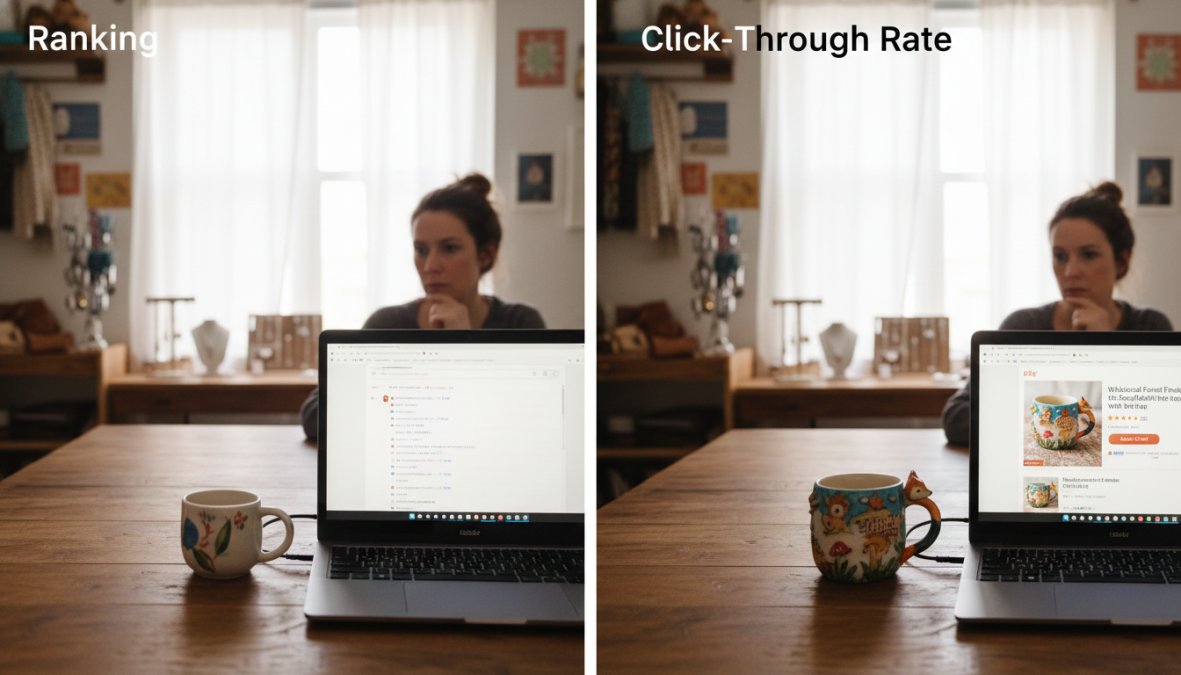
Google’s algorithm uses CTR as a relevance signal. If searchers consistently skip your result in favor of others at the same or lower position, Google interprets this as evidence that your listing is less relevant to that query and adjusts rankings downward over time. Conversely, a listing that earns above-average CTR for its position can improve its ranking without any change to the page itself. This feedback loop means CTR and ranking are not independent variables, they compound each other in both directions.
The Three Elements Google Displays for an Etsy Listing in Search Results
When an Etsy listing appears in Google’s organic results, a searcher sees exactly three things before deciding whether to click:
- The title, populated directly from your listing title (truncated at roughly 600 pixels of rendered width).
- The URL, Etsy’s standard format:
etsy.com/listing/[ID]/[slug-from-your-title]. The slug is auto-generated from your listing title, so a well-structured title also produces a cleaner, more readable URL. - The meta description, Etsy auto-generates this from the first sentence or two of your listing description. You do not control it directly through the title, but the title sets the topical frame that the description must reinforce.
The title is the only element you control directly through listing optimization. This makes it the primary CTR lever available to you.
Why Searchers Skip Results: The Psychology of SERP Decision-Making
Searchers scanning a Google results page make click decisions in fractions of a second, and the cognitive shortcuts they use are well-documented in UX research. Understanding these shortcuts lets you write titles that interrupt the scan pattern and earn the click.
Pattern 1: Query echo. Searchers look for their own words reflected back in the result title. If someone searches “personalized ceramic mug gift” and your title reads “Custom Pottery Coffee Cup – Handmade Stoneware,” they may skip it even if your product is exactly what they want, because their query words do not appear. The fix: use the searcher’s exact phrasing, not your preferred product vocabulary. “Personalized” and “custom” mean the same thing to you; they are different words to a scanner.
Pattern 2: Specificity as a trust signal. Vague titles read as low-confidence results. “Handmade Ring Sterling Silver” is vague. “Handmade Sterling Silver Stacking Ring – 2mm Minimalist Band” is specific. Specificity signals that the listing is exactly what the searcher is looking for, rather than a generic category page. Numbers, dimensions, and material specifications all function as specificity signals.
Pattern 3: The differentiator scan. When multiple Etsy listings appear on the same results page, which happens frequently for popular product categories, searchers scan for the word or phrase that makes one result different from the others. If every competing title uses “handmade” and “gift,” those words become invisible through repetition. A differentiator like “made to order,” “ships in 3 days,” or a specific material variant (“reclaimed oak,” “recycled silver”) breaks the pattern and draws the eye.
Pattern 4: Truncation anxiety. A title that is visibly cut off with an ellipsis in search results creates mild uncertainty, the searcher does not know what information was lost. Titles that fit cleanly within Google’s display window feel more complete and authoritative. This is a subtle effect, but it reinforces the case for keeping your most critical information within the first 55 characters.
Syntactic Patterns That Increase CTR in Etsy SERP Listings
Beyond psychology, specific syntactic structures consistently produce more clickable titles in Google results for handmade and craft product categories. These patterns work because they mirror how buyers naturally describe products they intend to purchase.
The Attribute Stack with a Separator:
[Primary Keyword] - [Specific Attribute] - [Use Case or Audience]
Example: “Handmade Leather Wallet – Slim Bifold Minimalist – Gift for Men”
The separator (dash or pipe) creates visual chunking in the SERP, making the title easier to scan. Each chunk answers a different buyer question: what is it, what makes it specific, who is it for.
The Query-Match Opening:
Begin the title with the exact phrase a buyer would type into Google, then extend it with differentiating detail.
Example: If buyers search “personalized name necklace gold,” open with exactly that: “Personalized Name Necklace Gold – Dainty Script Font – Custom Birthday Gift”
This maximizes query echo (Pattern 1 above) while adding specificity that competitors who front-load brand names or generic adjectives cannot match.
The Occasion Anchor:
For gift-category products, including a specific occasion in the title captures high-intent searches that competitors often miss.
Example: “Handmade Soy Candle – Lavender Vanilla – Mother’s Day Gift Under 30”
Occasion anchors work because gift searches are often time-sensitive and high-intent. A buyer searching “Mother’s Day gift under 30” has already made most of their purchase decision before they click. Matching that query precisely earns the click and the conversion.
Do not rotate occasion anchors across all your listings indiscriminately. If your title includes “Mother’s Day gift” and the listing ranks year-round, Google may suppress it outside the seasonal window when click-through rates drop. Reserve occasion anchors for listings you actively manage seasonally, or use evergreen phrasing like “gift for mom” that performs consistently throughout the year.
The CTR-Ranking Feedback Loop: What It Means Practically
The relationship between CTR and ranking creates a compounding dynamic that most sellers do not account for when auditing underperforming listings.
If a listing ranks at position six and earns below-average CTR for that position, Google’s algorithm interprets the low engagement as a relevance signal and may move the listing to position eight or nine over subsequent crawl cycles. Lower position produces even lower CTR, which reinforces the downward signal. A listing can drift off page one entirely without any change to the page content, purely because its title failed to earn clicks at its initial ranking position.
The reverse is also true. A listing at position six that earns above-average CTR, because its title matches query intent precisely and includes a compelling differentiator, sends a positive relevance signal. Google may test it at position four or five. Higher position produces higher absolute CTR, which reinforces the upward signal.
Practically, this means that when you audit an underperforming listing, low ranking position alone is not sufficient evidence that you have a keyword problem. You may have a CTR problem, a title that ranks adequately but fails to earn clicks. The diagnostic question is: does my title reflect exactly what the searcher typed, and does it give them a reason to choose my listing over the four results above it?
Optimizing for CTR is not a separate task from optimizing for ranking. A title written to earn clicks at position four will often earn a higher position over time, because Google’s algorithm treats sustained above-average CTR as evidence of relevance. Write titles for the human scanner first, and the algorithm will follow.
How to Test CTR Without Paid Tools
You do not need a paid analytics platform to assess whether your title is earning clicks. Google Search Console, which is free and available to any seller who verifies their Etsy shop’s domain (or monitors Etsy’s domain-level data through a connected account), provides impression and click data for individual listing URLs.
The metric to watch is CTR by query, the percentage of impressions that result in a click for a specific search term. If a listing receives hundreds of impressions for a target keyword but a CTR below two or three percent, the title is not earning clicks at its ranking position. That is a signal to revise the title using the syntactic patterns above, then monitor whether CTR improves over the following four to six weeks.
Because Etsy is a third-party platform, you will not have direct Search Console access to individual listing data unless you are embedding listings on a verified domain. However, tracking your shop’s overall organic performance in Search Console, even at the domain level, gives you directional data on which product categories are earning impressions without clicks, which is where CTR optimization effort should concentrate first.
Etsy SEO Best Practices for Shop Pages, Tags, and Metadata
Etsy SEO best practices extend beyond individual listing titles. Your shop page, tags, and listing metadata all contribute to how Google indexes and ranks your Etsy presence. Treating each element as an isolated optimization misses the compounding effect of a coherent, keyword-consistent shop structure.
Optimizing Shop Pages for Organic Search Indexation
Your Etsy shop homepage is a crawlable page that Google indexes independently of your individual listings. The shop title, shop announcement, and About section all contribute to the page’s topical signals. A shop title that includes your primary product category (e.g., “Handmade Sterling Silver Jewelry | MinimalistMetalCo”) provides Google with a clear topical anchor for the entire shop.
The shop announcement section, which appears near the top of your shop page, functions similarly to a homepage meta description. Writing it with relevant keywords while maintaining natural readability improves the page’s relevance signals for category-level search queries.
Many sellers neglect their shop’s About section entirely. For Google, this is a missed opportunity. A well-written About section that naturally incorporates your product category keywords adds indexable content to a page that is otherwise thin on text.
Using Tags Effectively to Reinforce Title Keywords
Etsy allows 13 tags per listing, each up to 20 characters. Tags do not appear in Google’s index directly, but they influence Etsy’s internal search ranking, which affects which listings Etsy promotes in its own Google Shopping feeds and organic search presence.
The most effective tagging strategy reinforces the keywords used in your title rather than introducing entirely new terms. If your title targets “handmade sterling silver ring,” your tags should include variations and related terms: “silver stacking ring,” “minimalist ring,” “boho jewelry,” “ring for women,” “handmade ring gift.”
According to Etsy’s guidance on tags and attributes, tags should represent the words buyers use to search for your items. Using all 13 tags with specific, relevant phrases rather than broad single words increases your listing’s surface area within Etsy’s search index, which indirectly supports your Google visibility by driving more Etsy-internal traffic signals.
Common Mistakes Etsy Sellers Make When Targeting Google Search
The gap between Etsy-optimized and Google-optimized titles is where most sellers leave organic traffic on the table. These are the mistakes that appear most consistently across underperforming shops.
Ignoring the 60-character mobile window. Sellers optimize for Etsy’s 140-character limit and bury their primary keyword after character 70. On mobile Google results, that keyword never appears. The fix: always front-load.
Using the same title structure across all listings. When every title follows the pattern “Handmade [Product] [Material] [Adjective] Gift,” Google sees thin, templated content. Vary your structure while maintaining keyword placement discipline.
Treating tags as a substitute for title optimization. Tags influence Etsy’s internal search but have no direct effect on Google’s indexation of your listing page. The title is the primary metadata Google reads. Tags cannot compensate for a weak title.
Optimizing for Etsy autocomplete only. Etsy’s autocomplete reflects what buyers search inside the marketplace. It does not reflect Google search volume or query patterns. A term that dominates Etsy autocomplete may have negligible Google search volume, making it a poor primary keyword for organic search targeting.
Never auditing existing listings. Title optimization is not a one-time task. Search behavior shifts, new competitors enter the market, and Google’s algorithm evolves. Sellers who set titles at launch and never revisit them miss opportunities to capture emerging long-tail keywords and fix duplicate title issues that accumulate as catalogs grow.
A practical audit checklist for existing listings:
- Does the primary keyword appear within the first 55 characters?
- Does the title read naturally as a product description?
- Is the title unique relative to other listings in your shop?
- Does the title include at least one specific product attribute (material, size, color)?
- Have you validated the primary keyword against Google Keyword Planner data?
- Does the title avoid keyword stuffing (reads naturally aloud)?
- Is the title free of filler words that consume character space without adding keyword value?
Running this checklist across your catalog once per quarter catches drift before it compounds into a ranking problem.
For sellers managing large product catalogs across multiple channels, tools like Embed360 address the operational side of this challenge directly. Embed360’s AI-powered listing optimization generates title and description suggestions designed for both marketplace and organic search visibility, while its real-time syncing ensures that title updates propagate consistently across WordPress, Shopify, Wix, and other connected channels without manual republishing. When you’re managing hundreds of listings, the difference between a systematic tool and a manual process is the difference between an audit that gets done and one that gets deferred indefinitely.
Managing Etsy title optimization at scale is genuinely difficult, especially when the same listings need to perform across multiple storefronts and search environments simultaneously. Embed360 addresses this directly: its AI-powered listing optimization crafts titles and descriptions for both marketplace and organic search visibility, while real-time syncing across WordPress, Shopify, Wix, Squarespace, and Google Shopping ensures every update goes live everywhere at once. Get started with Embed360 and build a title strategy that drives organic traffic from Google, not just from inside the Etsy marketplace.
Frequently Asked Questions
Does Google actually index Etsy listings?
Yes, Google indexes individual Etsy listing pages as well as shop pages. Each listing has its own URL that Google’s crawlers can discover and rank in organic search results. This means your listing title functions as the page title tag in Google’s search engine results page, making it one of the most important ranking factors for driving organic traffic from outside the Etsy marketplace. Optimizing your titles with Google-friendly keywords gives your listings a real chance at appearing in broader e-commerce search queries.
How many characters should an Etsy title be for SEO?
Etsy allows up to 140 characters for listing titles, but for Google SEO, the effective display limit is around 50-60 characters on desktop and even shorter on mobile. Place your most important long-tail keyword within the first 50-60 characters so it appears in full on the search engine results page. The remaining characters can include secondary keywords or product attributes. Avoid padding with irrelevant terms just to fill the character limit, as this can hurt your click-through rate and signal keyword stuffing to Google’s algorithm.
Do Etsy tags matter for Google search?
Etsy tags are primarily used by Etsy’s internal algorithm and are not directly visible to Google as standalone metadata. However, tags that align with your listing title and description reinforce topical relevance signals across your listing page, which can indirectly support indexation and ranking. For Google SEO, your listing title, description text, and shop page content carry far more weight. That said, a strong tagging strategy ensures consistency across your listing’s metadata, which supports both Etsy visibility and organic search performance.
What is the best Etsy title format for Google SEO?
The most effective format front-loads your primary long-tail keyword in the first 50-60 characters, followed by secondary product attributes separated by commas, pipes, or dashes. For example: ‘Personalized Wedding Gift for Couple | Custom Wooden Keepsake Box.’ This structure satisfies Google’s preference for descriptive, keyword-rich titles while remaining readable and compelling enough to earn clicks. Avoid duplicating the same title across multiple listings, as this creates a negative SEO impact by causing Google to treat them as competing duplicate pages.
How is Etsy SEO different from Google SEO?
Etsy SEO focuses on matching buyer queries within Etsy’s own marketplace algorithm, which weighs factors like recency, conversion rate, and shop quality scores such as Star Seller status. Google SEO, by contrast, evaluates the entire listing page as a web document, considering title relevance, page authority, inbound links, and user experience signals like click-through rate and dwell time. To optimize Etsy titles for Google, you need to think beyond Etsy’s internal search and treat each listing as a standalone landing page competing on the broader search engine results page.
